9
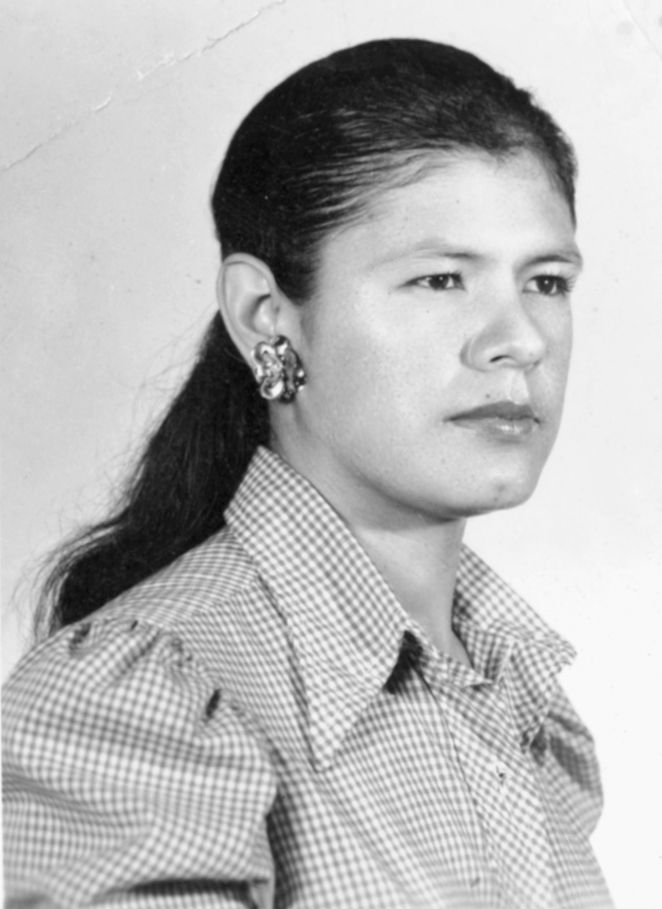
Tía Emperatriz
SCORPIONS HAD ALWAYS been a part of our lives. We were taught by Mami to check our shoes before putting them on in the morning and to search our bedcovers at night to make sure there were no scorpions in the folds. We had to shake our clothes before putting them on. We couldn’t lean against walls. We couldn’t reach into the wardrobe or drawers without fear of being stung by a scorpion hiding in the dark.
But at night, while you’re sleeping, there’s nothing you can do to keep a scorpion from crawling up onto the bed or, as in Abuelita Chinta’s case when she died in 2002, you can’t keep a scorpion from falling from the ceiling and stinging you.
So the night I woke up screaming for Mami, I recognized the pain right away from the two previous times I’d gotten stung. My right butt cheek burned as if I’d been branded by a red hot poker like the cows at the dairy farm down the road from my grandmother’s house.
“Mami! Mami!” I yelled.
“Nena, what’s wrong?” Mago asked.
“Scorpion,” I said.
Mago ran out of the room to get help. Carlos jumped out of bed and stayed by my side but didn’t touch me, as if he were afraid the scorpion would sting him, too. My grandfather kept on snoring and didn’t wake up to help.
“Mami!” I cried out again. My mother didn’t come to my side. Instead, it was my aunt who came running into the room, asking me where it hurt.
The scorpion was hidden on the collar of my dress, and when Tía Emperatriz pulled it off, I felt another sting on my neck. The pain spread up, pulsing in waves from my neck to my shoulders and up to my face.
“Mago, go slice an onion and get the rubbing alcohol!” Tía Emperatriz said. Mago ran to the kitchen while my aunt and Carlos hunted for the scorpion because the locals believed that if you killed the scorpion that stung you, its venom wouldn’t be as powerful. But they couldn’t find it.
“What’s all the fuss about?” Abuela Evila said as she stood by the door. When Tía Emperatriz told her about the scorpion, Abuelita Evila glanced around the room. “There it is,” she said, pointing to the straw-colored scorpion crawling high up on the wall, barely visible in the weak light from the bare bulb hanging above us. Everyone gasped as it squeezed its flat body through a crevice between the adobe bricks and disappeared from sight.
Tía Emperatriz rubbed alcohol over the stung areas and then tied the onion slices on them with strips of cloth. Tears bathed my face, and I felt as if a thousand hot needles were piercing my body. My face, my hands, and my feet were becoming numb. She sent Mago back to the kitchen for an egg, which she then forced me to swallow. It felt like a big ball of mucus sliding down my throat. Tía Emperatriz said the raw egg would dilute the venom. Back then I didn’t know any better than to believe this, so I made the knot in my throat loosen so the egg could slide down.
“We need to take her to the doctor,” Mago said as she sat next to me and squeezed my hand.
“There’s no money for that,” Abuela Evila responded.
“The venom might not do much harm, now that she’s eaten the raw egg,” Tía Emperatriz said. “Besides, look at you, Mago, when you’ve been stung, it’s as if nothing happened.”
“But that’s because my blood is hot and strong,” Mago said proudly. “And I’m a Scorpio, so scorpions don’t do anything to me. But please, Tía, take Reyna to the doctor.”
“There’s no money,” Abuela Evila said again.
“I’ll keep an eye on her tonight,” Tía Emperatriz said. “If she’s still not well in the morning, I’ll take her in. ¿Está bien?” Mago nodded. “Now, go back to bed, you two.” Tía Emperatriz picked me up and took me back to the living room where she slept on a bed tucked in a corner of the room. For privacy, she’d hung a curtain from the rafters. She lay down next to me, and I eventually fell asleep in her arms.

In the morning, the whole room spun around me. I couldn’t get up, and every time I tried to, I felt like vomiting. I wondered if this was how my grandfather felt when he was drunk. Abuelo Augurio liked to drink mescal, which is made from the heart of the maguey plant. When he would come home from the fields, he would sit outside on the stone steps taking sips out of his flask while watching the people go by on horses and on foot. He would call out to his friends and ask if they wanted a drink. When the smell of chorizo and boiling beans reached his nose, he would take one more sip of the mescal and make his way to the kitchen, holding on to the wall so that he wouldn’t lose his balance.
That morning, I was moving just like my grandfather, zigzagging two steps one way, one step the other way.
Tía Emperatriz missed work to look after me. I felt as if I had a guitar inside my head. She held me tight by the waist and walked me to the outhouse, but with every step I took the guitar strummed and strummed, the vibrations sending waves of pain that bounced inside my brain.
“She needs to see the doctor, Amá,” Tía Emperatriz said to Abuela Evila. “She’s burning up with fever. Let’s not take any chances. If anything happens to her, Natalio—”
“He and Juana chose to leave their children behind,” Abuela Evila said as she cleaned the beans. “I didn’t ask for this. Look at me. I’m seventy-one years old. Do I look like I need to be taking care of three young children on top of the one I’m already looking after?”
“They left so that they could build themselves a house, Amá,” Tía Emperatriz said.
“They won’t come back. Trust me.” Abuela Evila took her money bag out of her brassiere. “Look at María Félix. It’s been nine years, and every time Élida asks her when she’s finally coming back, she gives her excuses as to why she can’t yet. But that’s all they are. Excuses. And then it’s me who has to dry the tears, who has to find ways to lessen the pain.”

While my aunt and I waited by the dirt road for a taxi, I couldn’t stop thinking about my grandmother’s conviction that my parents were not coming back. Despite my dizziness and shivers, I was excited about the taxi ride, since I rarely got to ride in a car, or go anywhere outside of La Guadalupe. On the way to the doctor, I asked Tía Emperatriz if she thought Abuela Evila was right. “Do you think my parents won’t come back?”
“I don’t know, Reyna,” Tía Emperatriz said. “From what I’ve heard, El Otro Lado is a very beautiful place. But here …” She waved her hand for me to look outside the cab window. I know now what she had wanted me to see back then: the banks of the canal lined with trash and debris floating in the water, the crumbling adobe houses, the shacks made of sticks, the children with worm-pregnant bellies running around with bare feet, the piles of drying horse dung littering the dirt road, the flea-bitten stray dogs lying under the shade of trees, flies hovering above them. But what I saw back then I saw through the eyes of a child—a child who had never been anywhere, a child who was still innocent enough to see past the things later in life she could not. What I saw were the velvety mountains around us, the clear blue sky, the beautiful jacaranda trees covered in purple flowers, bougainvilleas crawling up fences, their dried magenta petals whirling in the wind. I saw the cobblestone street leading up to the beautiful La Guadalupe church, papel picado of all colors waving above the street.
“Don’t you think there’s beauty here, too?” I asked Tía Emperatriz. She looked out the window and didn’t answer. As the cab made its way to the heart of the city, I continued to think that there was beauty everywhere around us. But when the cab stopped in front of el zócalo, where I saw mothers and fathers strolling about holding hands with their children, I realized that it didn’t matter what I thought of Iguala.
Without my parents here, it was a place of broken beauty.

Though I felt better after the shot, Tía Emperatriz said I should sleep with her that night. I lay on her bed and watched her towel-dry her hair. She always bathed in the evenings because she said it helped her sleep better. She climbed into bed and turned off the light. It felt so strange to have a woman’s body next to mine. In the two years my mother had been gone, I’d forgotten what it felt like to sleep with her.
I listened to my aunt’s soft breathing. I wished I could close my eyes and snuggle next to her. I wished I could bury my face in her hair that smelled of roses. But instead, I moved to the other side of the bed, as far away as possible. I put my finger in my belly button and thought of my mother.
Mago would sometimes say, “I don’t see Tía as my mother. She’s more like an older sister to me.” And yet, when we walked through the gates of the school for our parent-teacher conferences, Mago would put her arm through Tía Emperatriz’s and look as proud as could be. She insisted Tía Emperatriz pick up her report card first. When we entered her classroom, Mago’s classmates and teacher looked at Tía Emperatriz with admiration. She looked so elegant in her red high heels, pretty blue dress, and stylish haircut.
“Is that your mother?” one of the students asked, because for a moment everyone seemed to have forgotten that our mother was very far away.
“She’s our aunt,” I quickly said.
Mago glared at me.
Just because she takes care of us when we’re sick, makes us pretty dresses once in a while, combs our hair up in ponytails without pulling on it, wants to know what we learned in school, notices when our underwear is full of holes and needs to be replaced, sees the dirt behind our ears and cares enough to make us bathe, that doesn’t mean she could take Mami’s place, I told Mago afterward.
“I said she’s like an older sister to me, okay?” Mago yelled.
And yet she was not happy when two months earlier we’d learned of Tía Emperatriz’s secret: she had a boyfriend. We were perched in the guamúchil tree when a taxicab pulled over and stopped right underneath us. As they kissed, Carlos and I covered our mouths and tried not to giggle, but Mago was shocked. They never saw us up there. We were very quiet, and they were too busy kissing to pay attention. Tía Emperatriz didn’t want Abuela Evila to know she had a boyfriend. She started wearing skirts a little above her knee, but when she came home she lowered them so that Abuela Evila wouldn’t see. Up from the tree, we could see her wipe the makeup off her face before coming into the house.
Abuela Evila never approved of any of my aunt’s suitors, so my aunt was already considered a spinster. She was going into her thirties, and women there start getting married as soon as they become señoritas, even to this day.
“You should be happy for her,” I told Mago as we watched Tía Emperatriz sneak out of the house to see her boyfriend.
“If she leaves, then what’s going to happen to us?” Mago said.
“Mami and Papi are coming back soon,” I said.
“Wake up, Reyna. Look over there, do you see that?”
I turned to look at Papi’s dream house. A foundation, one unfinished wall, exposed rebar. The house looked as fragile as the skeleton of the dead sparrow Mago and I once found in the vacant lot, which Mago said had been spit out by a snake.
“They aren’t coming back until that house is finished,” Mago said. “It’s taken Papi four years to build a foundation and half a wall. How long do you think it will take him to build the rest?”

On Monday I returned to school. It was Mother’s Day, my third Mother’s Day without Mami. The students in all grade levels were doing arts and crafts projects. In my class we made a bouquet of tulips using egg cartons, which we cut out and shaped before painting them red, yellow, or pink.
El maestro gave us pink paper so that we could make a card for our mothers. It was hard for me to write YO AMO A MI MAMÁ, as we were told to do. I folded the paper in half and then snuck it into my book.
I thought of the day I learned to spell “Mamá.” We were doing phonics, and el maestro wrote on the board MI MAMÁ ME MIMA. MI MAMÁ ME AMA. We had to repeat after him as he pointed to the words. “Mi mamá me mima. Mi mamá me ama.” My mama spoils me. My mama loves me. My throat began to close up, and I wiped the moisture from my eyes. When he said to write the sentences ten times I couldn’t stop my hand from shaking as I wrote the words down. And then I started to rearrange the words so that they formed a question: ¿ME AMA MI MAMÁ? Does my mama love me?
If so, why is she so far away?
As Mago, Carlos, and I walked home after school, we talked about the projects we had made. Mago’s class had made carnations with red yarn. Carlos’s class made posters using finger paints. He made a big heart that read “Te Quiero Mucho,” but he hadn’t written the name of the person he loved, either.
“Let’s give them to Tía Empera,” Carlos said. “Mami isn’t here anyway. She won’t find out about it.”
“We could give them to Abuelita Chinta, next time she comes,” I said.
“Tía Empera is nice to us,” Mago said.
“And today is Mother’s Day. Who knows when Abuelita Chinta is going to come,” Carlos said.
“We could save them for Mami,” I insisted. “We’ll give them to her when she returns.”

In the evening, Tía Emperatriz came home with a bouquet of flowers for Abuela Evila. She also brought rotisserie chicken for dinner.
It wasn’t until after her bath that Mago said we needed to decide what we wanted to do. When we couldn’t agree on anything, Mago stood up and said, “I’m going to give her my carnations. Do whatever you want.”
I glanced at the photo of Papi, wishing for the thousandth time that we had a photo of Mami, too. I was forgetting what she looked like, smelled like, felt like. I couldn’t remember the sound of her voice, the way she laughed. Every time I closed my eyes to remember, I would hear Tía Emperatriz’s laughter. If I took a breath, I would inhale the fragrance of Tía Emperatriz’s shampoo that smelled of roses.
I went to the living room where my aunt was drying her hair. “Tía, we want to give you this,” Mago said as she shyly handed the bouquet of yarn carnations to her.
“And this,” Carlos said, handing her the poster that read “Te Quiero Mucho.” I stood back. I held on to my bouquet of tulips and hid behind Mago.
“Oh, my goodness,” Tía Emperatriz said. “What a sweet surprise!” She took Mago’s and Carlos’s presents. I clutched Mago’s dress so hard that she yanked it away. She pushed me toward Tía Emperatriz.
It was so difficult for me to completely give myself over to my feelings for Tía Emperatriz. As much as I loved her, there were two possibilities hovering in the horizon that would separate me from her. Either my parents would return soon or she would marry and leave to have children of her own. Either way, I would lose her. After having already lost both my parents, how could I bear to get attached to someone I would lose as well?
But she’s here now, I had told myself that evening, and so I walked to her and offered her my gift.
“Here, Tía,” I said. “I made this.” I couldn’t bring myself to say “for you” because it wasn’t true.
“Thank you so much for this, niños,” Tía Emperatriz said, giving us each a hug. As we went back to our room, I looked back at Tía Emperatriz, who was putting our art projects on her nightstand. I ran back to give her one more hug.
“Thank you, Tía,” I said, and I went back to my room and dreamed of roses.