7
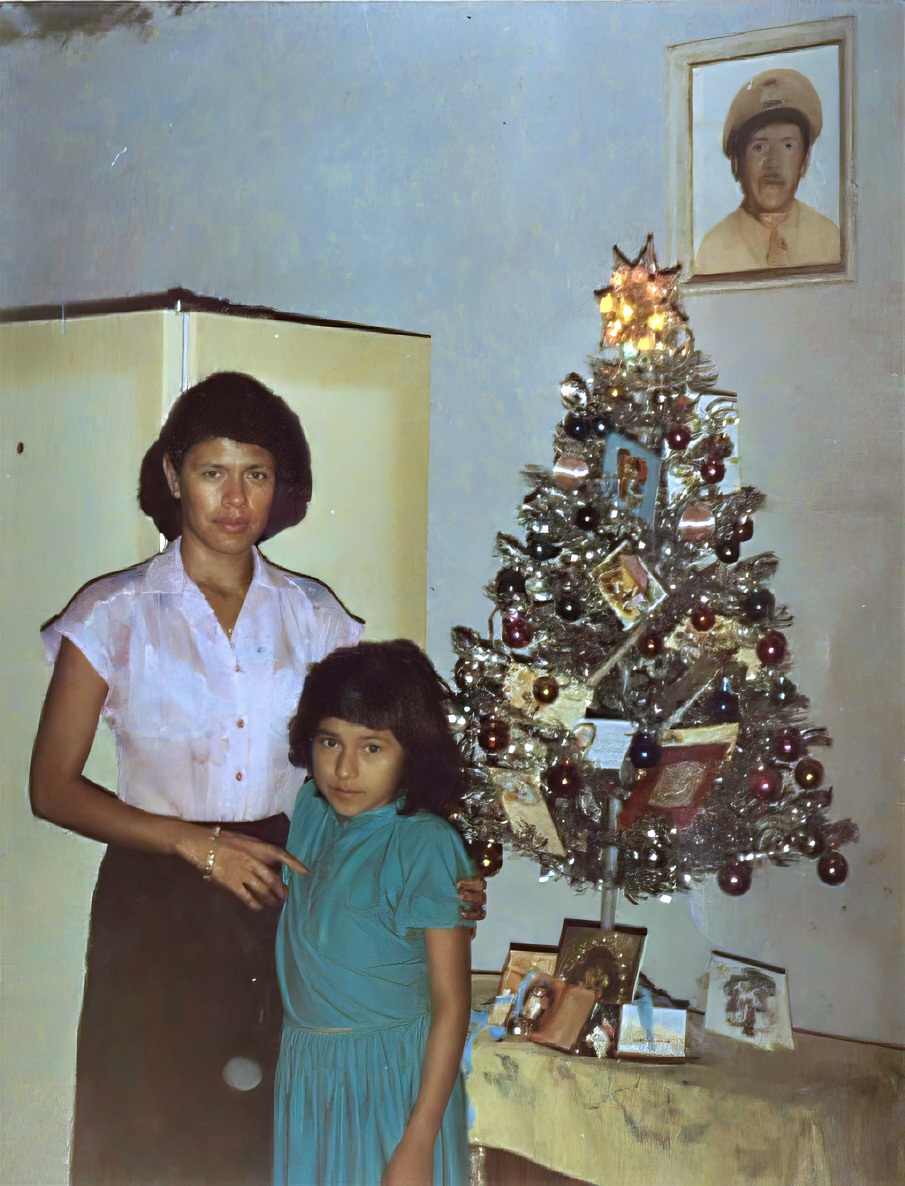
Tía Emperatriz and Mago
MAGO AND ÉLIDA were in the habit of standing by the gate every afternoon to wait for el cartero, the mail carrier who came by on his bicycle. If he had mail for you, he would ring his little bell, a soft tinkling sound that could be the most beautiful sound in the world if only the mail were for you.
Instead, the sound of the bell was a little needle that pricked my heart because he never rang the bell for us. Always, the tinkling was for Élida or the neighbors.
One day, we watched him riding clumsily down the dirt road because he wasn’t as good a rider as the baker. He had a box tied to the rack on the back of his bike, and as he neared the house, the tinkling of the bell began. But my heart was already breaking because I knew the sound wasn’t for me. Élida pushed us out of the way and smiled at el cartero, her arms ready to receive the box. Christmas was in two days. Even though in Mexico children don’t get presents on Christmas but rather on January 6, the Day of the Three Wise Men, Élida said her mother had sent her a Christmas present because that is what they do in El Otro Lado, and her mother knew all about American culture.
But the box was not for Élida! El cartero handed Mago the box and then was off to the next house.
“He made a mistake, that stupid man,” Élida said as she tried to yank the box from Mago.
“There’s no mistake,” Mago said. Carlos and I held on to the box, too, in case Élida tried to snatch it away. When she saw Mago’s name on the box, Élida stomped away and went into the house, calling out for Abuela Evila.
We quickly opened the box to see what was inside. Papi and Mami had sent Mago and me two identical dresses. The top was white and the bottom was the color of purple jacaranda flowers. The collar was trimmed with lace and in the center of it was a beautiful silk orchid. We also got shiny patent leather shoes. Carlos got a pair of jeans and a shirt.
We rushed to my grandfather’s room to put on our pretty clothes. But it was as if our parents had not realized that while they’d been gone we had grown, as if somehow in El Otro Lado time stood still and over there I hadn’t yet turned six, Mago ten, and Carlos almost nine. The shoes they sent were a size too small, and so were the dresses. The sleeves of Carlos’s shirt were two inches above his wrists. The skirt of my dress didn’t even graze my knees.
“What do we do now?” Carlos asked, unbuttoning his new shirt. “Maybe they should have sent us some toys.”
Mago hit him on the head.
“Ouch, what did you do that for?” Carlos asked, massaging his head.
Mago sat down on the bed. “I don’t know,” she said. She looked down at the dirt floor, and I wondered what she was thinking. Part of me was desperate to wear those shoes. They were new. They had been sent to us by our parents. They were from El Otro Lado! But then I thought about my parents, and the fact that they didn’t even know what size shoe I wore made me want to throw them in the trash.
If they don’t even know something as basic as the size of our shoes and clothes, what else don’t they know about us? And what don’t we know about them?
The question was there, but neither Carlos, Mago, nor I was courageous enough to ponder on it for long. As the oldest, it was clearer to Mago, more than to Carlos and me, that the distance between us and our parents was destroying our relationship more than any of us could have imagined. And the consequences would be great. But back then, as our little mother, Mago’s job was to take care of us and to shelter us from the reality that only she could fully grasp. I had her as a buffer, but she had no one but herself.
“Come on, Nena, let’s wash our feet,” she said. So we washed away the dirt caked on our feet and we put on the beautiful shiny shoes. “Curl your toes inward,” Mago said to me. I curled my toes and that way the shoes didn’t hurt as much.
Mago, Carlos, and I held hands and we started spinning around in a circle, turning and turning, blending into a blur of purple, pink, white, and blue. Then, without letting go, we ran out of the house, out into the street, laughing and crying at the same time.
And as we ran past Don Bartolo’s store, then cut across the vacant lot, then headed to the church, past the tortilla mill, and Don Rubén’s little house, everyone stared at our beautiful new clothes, and not once did anyone say, “Poor little orphans.” Our neighbors admired our pretty clothes and shoes from afar, not knowing that by the time we got home our feet would be covered with blisters.