6
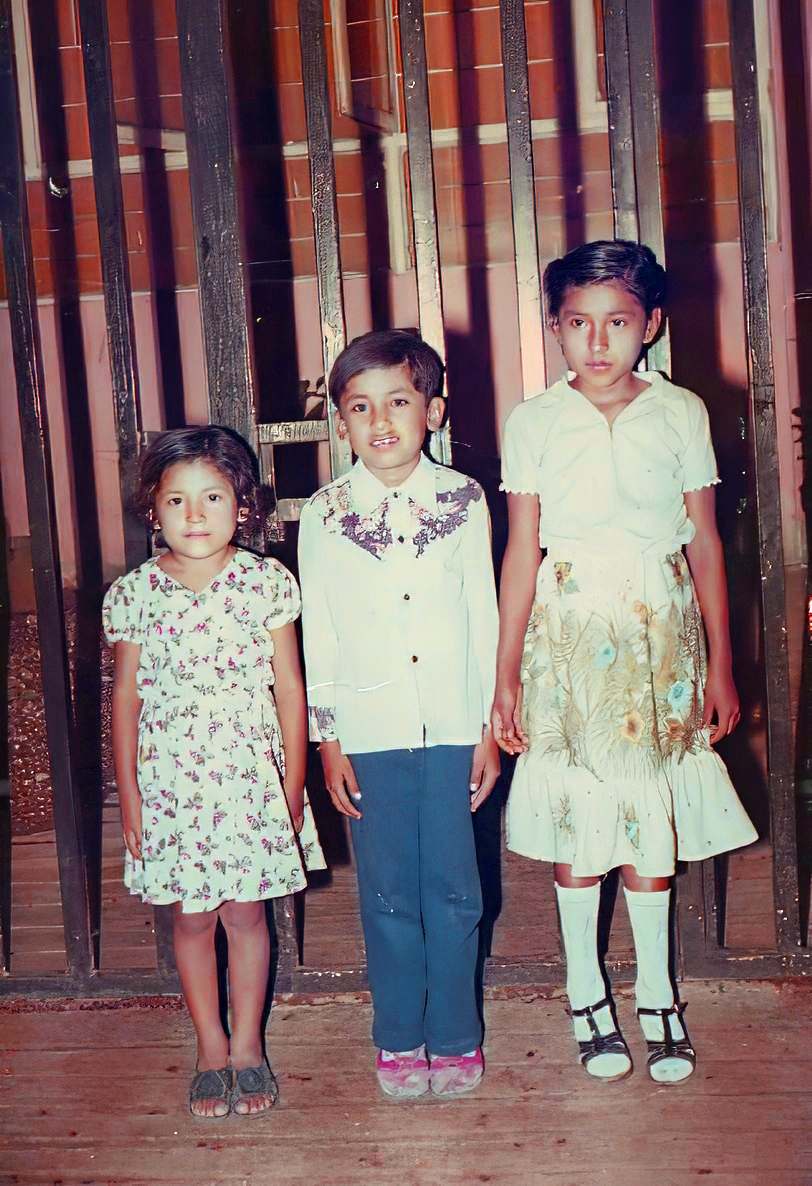
Reyna, Carlos, and Mago
IT WAS 8:00 AM sharp, and Carlos, Mago, and I lined up with the rest of the students around the school’s courtyard to salute the flag.
“Who are they?” I asked Mago. I tugged on her dress and asked again, as I pointed to a group of six students wearing white uniforms and not the navy blue ones everyone else was wearing.
“That’s la escolta,” Mago said.
“And what do they do?” I asked.
“Just wait and see, and stop bugging me with all your questions. You’ll soon learn your way around here.”
I couldn’t help being excited to be there. It was my first day of first grade. I’d been waiting for this day for a long time. Abuela Evila didn’t send me to kindergarten because she said it was too expensive to have all four grandkids in school, as if my parents hadn’t been sending money to pay for uniforms, school supplies, and the monthly school tuition. Even though we went to public school, there was nothing free about it. She held me back a year, but finally I was there, and I would get my own books, like the ones Mago and Carlos brought home. Books full of beautiful poetry and fun stories with colorful pictures of clouds, stars, people, and animals like foxes and birds. I liked it when Mago read to me from her books, but I wanted to learn to read them myself.
Tía Emperatriz spent the weekend at my grandmother’s sewing machine making our school uniforms. On Mondays, when we honored the flag, we had to wear a uniform in navy blue with a white sailor shirt. The uniform for the rest of the week was made of a checkered print in white and green. We also got new patent leather shoes and a few pairs of knee-high socks with the extra money our parents sent.
The color guard began its march around the courtyard. The student in the middle carried the flag on a pole, another shouted out directions: “¡A la izquierdaaa, ya! ¡A la derechaaa, ya!” The green, white, and red colors of the flag blurred in my mind like salsa.
“I’m going to be a flag bearer when I’m in sixth grade,” Mago said as she stared longingly at the escolta members, looking great in their crisp, white uniforms. I believed Mago would be a flag bearer one day. She was really smart and always brought home good grades, mostly tens and nines, not like Carlos who, with fives and sixes, almost flunked first grade. How shameful.
“I’m going to be a flag bearer, too,” I told Mago. She laughed and said that it was my first day of first grade, and sixth grade was ages away. And I said it didn’t hurt to plan for the future.
As the flag passed by me, I stood straighter and maintained my hand firmly pressed again my chest in salutation as I sang the Mexican anthem as loud as I could.
Mexicanos, al grito de guerra
el acero aprestad y el bridón.
¡Y retiemble en sus centros la Tierra,
al sonoro rugir del cañón!
Mago told me that we should be proud to have been born in Iguala because it was in our city that the treaty which ended the Mexican War of Independence was drafted. It was in Iguala that the first Mexican flag was made by a man named José Magdaleno Ocampo on February 24, 1821. This is why Iguala is called “Cuna de la Bandera Nacional,” Birthplace of the National Flag. The first time the national anthem was sung, it was sung in Iguala.
I looked at the flag with new eyes, a newfound admiration, and as I sang el himno nacional on my first day of school, I puffed up my chest, feeling especially proud about being born in Iguala de la Independencia!
My school was small. It was laid out in a square, with all the classrooms facing the courtyard. It had two bathrooms, one for boys and one for girls, but no running water. We had to fill up a bucket from the water tank inside and dump it in the toilet. But still, at least there was a toilet, although it was hard for me to get used to it after having to squat on the ground my whole life.
When the morning activities were over, we lined up, and our teachers led us into our classrooms. We took our seats and after a brief introduction, el maestro started the lesson by teaching us the alphabet. He said we should have learned it in kindergarten, but half the students in the class hadn’t gone to kindergarten. We repeated after him, and I felt proud that I knew my letters already because Mago had taught them to me. When he told us to write our names down, I didn’t have to look at the board to spell my name: R-E-Y-N —I felt a stinging on my hand, and it took me a second to realize that el maestro had hit me with his ruler.
“What are you doing?” el maestro asked. He held his ruler in his right hand and tapped it over and over on the palm of his left hand.
“I’m writing my name,” I told him. “See?” I raised my brand-new notebook to show him.
“You are not to write with that hand,” he said to me. He took the pencil from my left hand and made me grab it with my right. “If I see you using your left hand, I will have to hit you again, ¿entiendes?”
My eyes welled up with tears because everyone was looking at me. I took a deep breath and nodded. He walked away, and I looked down at my notebook. I wrote and erased, wrote and erased, and no matter how hard I tried, the letters didn’t come out right. It was like trying to write with my feet.
Abuela Evila and Élida always teased me for being left-handed. My mother’s father, Abuelito Gertrudis, had also been left-handed. Because he died a week before I was born, Mami said he had given this gift to me. And that is how I had always seen it, as a gift, until we came to Abuela Evila’s house. She didn’t agree. She said that the left hand was the hand of the devil and I was evil for using it. Sometimes during meals, she would hit my hand with a wooden spoon and tell me to eat with my right hand.
“Don’t you know that the right side is the side of God?” she asked. “The left side is the side of evil. You don’t want to be evil, do you?” Since I didn’t want anything to do with the devil, I would pick up my spoon with my right hand and try to eat with it. But I could only manage a few bites before my spoon found its way back to my left hand.
Measles crippled my grandmother’s left arm when the open sores got so infected they were crawling with maggots, but she would tell me that if I kept using my left hand it would shrivel up, just like hers. Even though it was a disease that crippled her, I lived with the constant fear of waking up one day with a shriveled left hand. It was ironic that it was Abuela Evila who ended up shriveling when osteoporosis set in several years later. And it would be Tía Emperatriz who had to change her diapers, who continued to tend to her because nobody else would.
“Don’t listen to her, Nena,” Mago would sometimes tell me. “There’s nothing wrong with being left-handed.” But just as Mago couldn’t ignore Élida’s taunts about her scars, I couldn’t ignore Abuela Evila’s or my teacher’s. He didn’t understand that my pencil obeyed my left hand, but not the right one. I tried once again to write my name, but the letters came out all twisted and ugly. When Mago taught me to write my name, she wrote it with beautiful letters and made the tail of the Y long and curly. It looked so pretty it made me finally start liking my name. I used to hate my name because sometimes when Mami and I were on our way to el mercado, men would whistle at Mami from across the street and yell “¡Mi reina!”—my queen—and the way they said “mi reina” made me want to throw a rock at them and make them bleed. Then I would ask Mami why she gave me a name that sounds so foul in a man’s mouth. I asked why she couldn’t have just named me Regina, as Abuela Evila had wanted. I wished she had chosen another time to rebel against my grandmother’s bossy ways. “Reyna is a very nice name,” Mami would say. “Those men are just not saying it the right way. And it wasn’t your grandmother’s place to name you. You aren’t her daughter!”
I looked at my name on the notebook. I had never hated it as much as I did at that moment. And I didn’t stop hating my name until many years later, when I realized that it wasn’t a name to be ashamed of, but one to live up to.

I met Mago and Carlos during recess by the jacaranda tree in the courtyard. By the entrance of the school, women were selling food. They had brought baskets filled with enchiladas, taquitos, and potato picaditas. The smell of the chile guajillo sauce, fresh cheese, and onion wafted toward us, and I asked my brother and sister why we weren’t getting in line to buy food.
Mago laughed.
“Our grandmother never gives us money,” Carlos said. “You better get used to it.”
We watched the women put the food on paper plates and hand it to the students who did bring lunch money. We weren’t the only ones drooling over the enchiladas. At least half of the children in the school were leaning against classroom walls, grabbing their empty bellies while looking at the food stands.
For the second time that day, I felt my eyes stinging with tears. “I hate school,” I said.
“Why, because you’re hungry?” Carlos asked. “I like it. At least it gets us out of our grandmother’s house. Imagine if we had to be there all day long?”
“I’ve been there all day long all this time,” I said. “Until today.”
“Then you should be happy to be here,” Mago said, but she didn’t look at me. She was looking at a boy in my class who was heading toward us eating a mango on a stick.
“The teacher hit me because I was writing with my left hand,” I said. “I think I’d rather stay home and clean Abuela Evila’s house from top to bottom than to go to school.”
“So you would rather stay home with our grandmother?” Mago asked. “I don’t believe it.”
I looked at the glass containers of agua fresca at the food stands: agua de melón, sandía, piña. From here, I could see the large cubes of ice swimming inside the glass containers. My throat was so dry I imagined that this was how the earth felt after months and months of waiting for rain. Mami used to say that the clouds go down under the mountains to drink water from the rivers, and once they’re full they come up to the sky, ready to bathe the earth. Sometimes the clouds take too long to drink water and that’s when the grass withers, the flowers die, the water in the canal narrows to a trickle and almost disappears. But sometimes the clouds drink too much water, and that’s when the floods happen. Days and days of never-ending rains that turn the gentle river waters into aguas broncas, tearing down trees and dragging everything in their path, then spilling over the banks and bursting into people’s homes.
Mago gasped, and I turned to see what she was looking at. The boy in my class had dropped his mango on the ground. He began to reach for it, but then stood up and walked away from it looking really sad. I looked at Mago and knew what she was thinking.
Every time we went out to run errands, she was always looking around to see if she could find a half-eaten fruit or a lollipop some unlucky kid had dropped. Sometimes she got lucky. Sometimes she didn’t.
Mago looked at the mango, and I knew she couldn’t resist picking it up. “Go get it,” she told Carlos as she pointed to the mango.
“You go,” Carlos said.
“Some of my classmates are over there. They’ll see me. Ándale, you get it, Nena.”
“No,” I said. Mago looked at me, and I knew that sooner or later she would make me do it. “Mago, you shouldn’t eat things from the ground. They’re bad. They’ve been kissed by the devil,” I said.
Mago waved my words away. “Those are just tales Abuela Evila likes to scare us with,” she said. Abuela Evila used to say that when food falls to the ground, the devil, who lives right below us, kisses it and taints it with evil. “Look, I don’t know if the devil exists or not, and I don’t care. I’m hungry. So go get it!”
Mago pushed me toward the mango, but I shook my head. Tales or no tales, I wasn’t going to risk it. But my mouth watered at the thought of sinking my teeth into the mango’s crunchy flesh.
The bell rang, and the kids rushed back to their classrooms. Mago and Carlos waved and disappeared from sight. I stood there under the jacaranda tree, and my feet didn’t want to move. I didn’t want to go back to the classroom. I didn’t want to go back and struggle to hold my pencil with my useless right hand. I didn’t want to see el maestro looking at me and making me feel ashamed, making me feel as if I were evil. I didn’t want him to hit me again and have my classmates jeer and laugh. But if I didn’t go back, I knew I wouldn’t learn to read and write. How could I ever write a letter to my parents and ask them to please, please, come back?
As I made my way to the classroom, I noticed the mango again. It lay on its side, its flesh yellow like the feathers of a canary. It was covered with red chili powder and dirt. And what if Mago is right? I asked myself. What if the devil doesn’t exist? If he doesn’t exist, that means the left side isn’t the side of the devil. And that would mean I am not evil for being left-handed.
I looked around, and the courtyard was now empty. I bent down and picked up the mango, flicked the dirt off, and sank my teeth into it. The chili powder burned my tongue. The burning sensation made me feel warm all over. I stood there waiting for something to happen. I waited to see if the devil was going to burst out of the earth on his horse and drag me to hell with him. The jacaranda waved in the breeze, looking beautiful with its bright purple flowers. From above the brick fence, I could see the colorful papel picado hanging in rows over the cobblestone street. The church bells started ringing, and I turned to look at the two towers at the top of the hill, the metal cross glistening under the bright noon sun.
I returned to class, and el maestro looked disapprovingly at me. I sat at my desk and looked at my pencil. From the corner of my eye, I saw el maestro making his way toward me, his ruler going up and down, up and down. I reached for my pencil and clutched it tightly in my left hand.