5
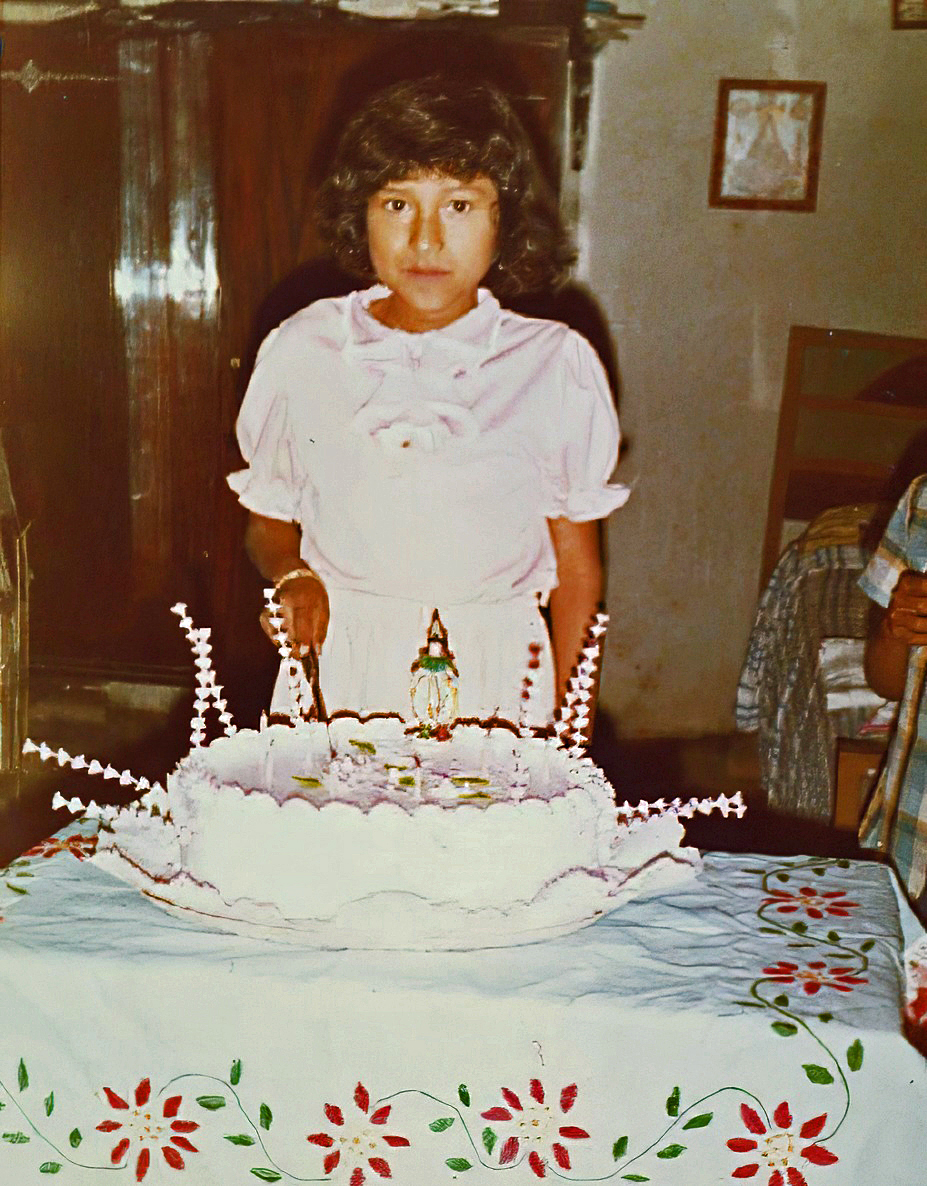
Mago cutting her and Reyna’s birthday cake
A MONTH LATER on September 7, just as the rainy season was coming to an end, I turned five, but my birthday came and went without notice. Since Mago’s birthday is in late October, Abuela Evila said our birthdays would be celebrated together. That meant I had to wait a month and two weeks. That whole time I was angry at Mago because it was easier to take it out on her than to rebel against my grandmother’s decision. Why did Mago have to be a hot-blooded Scorpio and not an easygoing Virgo, like me? Why couldn’t it be she who celebrated her birthday early, instead of me celebrating mine late?
Finally, one Saturday morning, my grandmother reluctantly handed Tía Emperatriz the money my parents had sent to buy us a cake. My aunt did more than that. She came home with a roasted chicken, two cans of peas and carrots, which she used for a salad, and small presents for me and Mago: shiny ties and barrettes for our hair. This was the third birthday I celebrated without Papi being there. The first without Mami.
The cake was beautiful. It was white and had pink sugar flowers all around. My grandmother’s oldest daughter brought her children to the house, not because she cared about our birthdays, but who could resist getting a free meal and a slice of cake? Even Élida put her pride aside and asked for seconds. Not once did she try to ruin our special moment with one of her usual remarks about us being orphans. That’s what a fancy store-bought cake does to people.
Tía Emperatriz took pictures of us cutting the cake to send to my parents. We rarely had our photographs taken, and the thought of these pictures making their way to El Otro Lado—to Papi and Mami—was exciting. I thought those pictures would remind them of us, and that way they wouldn’t forget they still had three children waiting for them back home. I smiled the biggest smile I could manage because I wanted them to know I appreciated the money they’d sent for the cake. Carlos smiled halfway. He was very self-conscious about his teeth. Back then, not only were his teeth crooked, but there was also a tiny little tooth wedged between his two front teeth. Since he didn’t want anyone to see them, he would purse his lips and smile without showing any teeth. He looked as if he were constipated.
Mago didn’t smile. She said that if she looked sad, then maybe our parents would see how much she truly missed them, and they would come back. From that point on, she continued to look sad in almost every picture we took.
Her tactic didn’t work. The pictures were sent, the months went by, and still our parents did not return.

The one who did come back, however, was Élida’s mother.
We had been at Abuela Evila’s house for over a year when Élida turned fifteen. She officially became a señorita, and Tía María Félix came to Iguala to throw a big quinceañera for Élida. She arrived loaded with so many suitcases she hired two taxis to take her from the bus station to Abuela Evila’s house. While everyone greeted her and made a big fuss about her arrival, we eyed the suitcases, wondering if our parents had sent us something.
Élida’s little brother, Javier, was six years old. He held on to Tía María Félix and when Élida tried to hug my aunt, Javier pushed Élida away and said, “No, she’s my mommy.” Tía María Félix laughed and said it was cute. Abuela Evila scolded him and said that Élida was his sister, and Tía María Félix was Élida’s mother, too. But he wouldn’t let go of his mom.
Mago would have taken advantage of this opportunity to say something mean to Élida. But the news Tía María Félix gave us sent us to our room, where we spent the night crying. “Your mother just had a little girl,” she said. “Elizabeth, I think, is what your mom named her.”
We lay on our bed, huddled so close together our limbs were entangled. At night, barking dogs serenaded la colonia as they wandered through the dark streets. We listened to them, watching their shadows streaming in through the small window. What’s her name? I wondered. Elisabé? I’d never heard this name before.
“A baby girl,” Mago said, breaking the silence. And it suddenly hit me: I was no longer the youngest. Some other girl I did not know had replaced me.

The next day all my cousins showed up to see what Tía María Félix had brought for them from El Otro Lado. We didn’t see our cousins often, but now they were all there, having come as soon as they heard Tía María Félix had arrived. We watched as she gave our cousins presents—a shirt, a pair of shoes, a toy. We waited our turn, and when the suitcases were empty, Tía María Félix turned to us with a sad look on her face and said, “Your parents sent you something, but unfortunately I lost that suitcase at the airport.”
“That’s a lie,” Mago said softly.
“What did you say?” Tía María Félix asked.
“Those toys that you gave away were for us!” Mago yelled. “I know it. I just know it.” I wanted to believe that Mago was right. The thought that our parents had neglected to send us gifts really hurt. What if they had been too busy tending to their new baby to think about us?
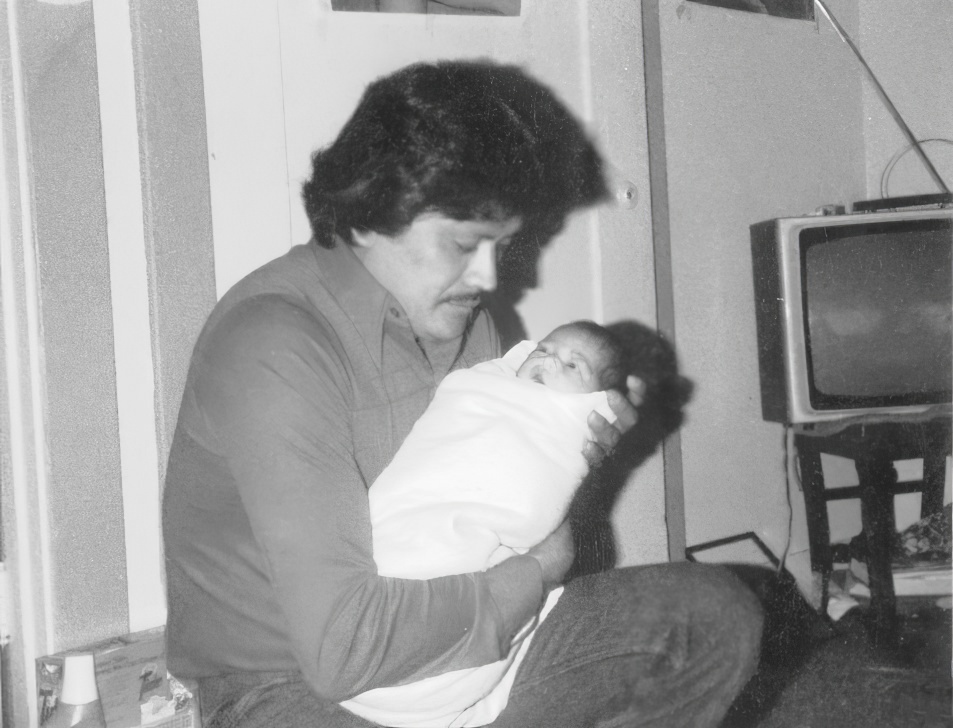
Papi and Elizabeth in El Otro Lado
“You insolent child,” Abuela Evila said. “I’m going to teach you to respect your elders.” She looked around for something to hit Mago with, and when she couldn’t find anything, she took off her sandal. By the time she unbuckled the strap, the three of us were already bolting out the door and heading to the backyard to climb up the trees.
“She could have given us something from the stuff she brought. It’s not our fault she lost the suitcase,” Carlos said.
“No seas pendejo,” Mago said, punching him on the arm. She jumped off the branch, climbed over the corral, and disappeared down the dirt road that led to Don Rubén’s house.

The preparations for Élida’s quinceañera were completed quickly because Tía María Félix had to return to her job in El Otro Lado. Tía Emperatriz spent hours making decorations for the hall, and Mago and I had to help. The times we refused, Tía María Félix spanked us under Élida’s mocking gaze. We made garlands using paper flowers and straws. Abuela Evila spent all day making dresses on her sewing machine. Élida’s dress was made in the U.S. because Tía María Félix said she had to have the best for her daughter. But when Élida tried it on, the dress wouldn’t zip up. She was put on a crash diet, and Tía María Félix bought her a girdle. Even then the dress wouldn’t fit, so it had to be altered.
By the end of the week everyone had a new dress except for Mago and me. It wasn’t until the day before the party that Abuela Evila was finally done with everyone else and was able to start on our dresses. She bought a few yards of a silver material, shiny like a brand-new peso. She made Mago’s dress first. In the evening, she made my dress. By then she was so tired she made a mistake. The shiny part was on the inside. The dull part was on the outside.
“But, Abuelita, I can’t wear the dress like that, it looks like I’m wearing it inside out! Please fix it.”
“I’m too tired,” she said as she stood up and stretched her back. “You’re going to have to wear your dress just as it is.”

The next day we watched while everyone fussed over Élida. A hairstylist came and did her hair up in tiny braids held together by pink and white bows. Then her mother, our grandmother, and Tía Emperatriz helped her put on the crinoline, the girdle, and the beautiful pink dress made with layers of satin and tulle. I hated seeing Tía Emperatriz fussing over Élida so much. Usually she didn’t pay much attention to her, but she was always nice to us.
While everyone was at church for the ceremony, we spent the whole morning plucking chickens. Tía María Félix hired a woman to help with the cooking, and she showed up with huacales of live chickens clucking and shedding feathers that floated in the air like white flower petals.
She killed the chickens by grabbing them by the head and spinning them around like a matraca until the necks broke. She told Carlos to help her, but he was too gentle on the chicken, and when he put it down, the poor chicken had a broken neck but still ran around and around, its head hanging to one side.
The cook told him he was no good at killing chickens and made him help Mago and me pluck feathers. Our job was to hold the dead chickens by their feet and dunk them into boiling water to soften the skin. Then we put a chicken on our lap and pulled out the feathers. We complained about having to do it. “Why should we be helping out for Élida’s party?” we wanted to know. I’d never plucked a chicken and couldn’t pull hard enough for the big feathers to come out. The small downy feathers would stick to my fingers, and I couldn’t scratch my legs when mosquitoes bit me. Carlos kept complaining that this was a girl’s job, and why should he be plucking chickens?
“Because you aren’t man enough to kill them,” the cook said.
Mago loved plucking chickens. She threw herself into it with a frenzy, and she plucked, plucked away, plucking so hard sometimes the chicken skin would come off along with the feathers, and I wondered what the poor chickens had done to her to deserve such fury.
By the time we were finished, the whole patio was covered in feathers. Flies buzzed around, settling on the chicken guts spilled on the ground as the cook chopped the meat to pieces on the washing stone before boiling it.
Afterward, even though we took a bath and scrubbed ourselves hard with the apple-scented shampoo we liked, we still smelled like wet chicken feathers, and once in a while throughout the evening we pulled out feathers buried in our hair. I pretended I was turning into a dove. I imagined flying in search of my parents.
The quinceañera was held at a beautiful hall near la colonia called Las Acacias. Élida looked like a princess wearing her puffy pink dress and matching slippers. Mago spent the whole time sitting in a corner of the hall, feeling sorry for herself, her jealousy consuming her to the point where she couldn’t even talk without saying a bad word in every sentence. “That stupid frog-eyes doesn’t deserve this stupid party.”
Carlos, who didn’t get any new clothes, took advantage of the fact that everyone was too busy to see him sneaking into the kitchen to grab some sodas and a plate piled high with chicken mole and rice. I spent the whole time hiding from people, ashamed about wearing a dress that had the shiny part on the inside and the dull part on the outside. It’s a new dress, I told myself again and again, I should be happy because it’s a new dress. But I crawled under a table and cried about the dress, and about the fact that my parents had replaced me.
I only came out to see the waltz, which is the highlight of any quinceañera party. Élida danced with her chambelán, and when that waltz was over, she danced with her godparents. The last waltz was meant to be danced with her father, as is tradition, but since she had no father, she danced that waltz with my aunt’s cousin, Tío Wenceslao, who was a butcher. He raised and killed pigs and had a restaurant in La Guadalupe where he sold pozole, chorizo, chicharrón, and everything else that comes from pigs. “Look at her, dancing with the pig man,” Mago said. “How appropriate.”
My eyes got watery as I watched Élida dance with the butcher whom we called uncle even though he wasn’t an uncle but a distant cousin. But since the only male she could have danced with—our grandfather—was passed out on a chair from too much drinking, and the other male—my father—was away, what choice did Élida have but to dance with this man, this distant cousin of ours?
I prayed and hoped for Papi to come back soon. When I turned fifteen, I didn’t want to dance El Vals de las Mariposas with anyone but him.

Carlos had been following Élida’s American brother around to ask him to say things in English. When little Javier did, Carlos would burst out laughing so hard, he didn’t care that everyone could see his crooked teeth. He thought Javier sounded so funny speaking English. “Do you really think it’s English he’s speaking, or is he just making up words?” Carlos asked us.
Mago said, “He could be speaking Chinese for all we know.” Back then, I could never have imagined that one day, I would speak English better than I spoke my native tongue.
As Tía María Félix was packing her suitcases and getting ready to leave, Carlos went up to ask her what El Otro Lado looked like. He said he wanted to know more about the place where our parents lived. My aunt looked at him and didn’t say anything, and we thought that maybe she wouldn’t answer, but then she smiled and said:
“El Otro Lado is a beautiful place. Every street is paved with concrete. You don’t see any dirt roads there. No mosquitoes sucking the blood out of you,” she said, as she slapped a mosquito dead on her leg. “There’s no trash in the streets like here in Mexico. Trucks there pick up the trash every week. And you know what the best thing is? The trees there are special—they grow money. They have dollar bills for leaves.”
“Really?” Carlos asked.
“Really.” She took some green bills out of her purse and showed them to us. “These are dollars,” she said. We had never seen dollars, but they were as green as the leaves on the trees we liked to climb. “Now, picture a tree covered in dollar bills!”
She left in the afternoon with little Javier. She promised Élida that one day soon she would send for her, and although she did eventually keep her promise, Élida had to stay behind for now and watch a taxicab take her mother away. Abuela Evila put her arm around Élida and held her while she cried. Élida buried her face in Abuela Evila’s arms. It was so strange to see her crying. The ever-present mocking gaze was gone. The Élida that made fun of us, that laughed at us, that called us Los Huerfanitos, had been replaced by a weeping, lonely, heartbroken girl.
Mago grabbed our hands and took us to the backyard to give Élida privacy. “Los quiero mucho,” she said, pulling us close to her. Then I realized how lucky Mago, Carlos, and I were. We at least had each other. Élida was on her own.
We climbed up the ciruelo and talked about those special dollar trees in El Otro Lado. Even though we knew that what Tía María Félix had said couldn’t be true, we fantasized about them anyway.
“If we had trees like that here, Papi wouldn’t have had to leave,” Mago said. “He could have bought the brick and cement and built us a house with his own hands.”
“And Mami would still be with us,” I said.
“And the new baby would have been born here, like us,” Carlos said.
We talked about the day our parents would return. Carlos’s fantasy was that Papi and Mami would fly to us in their own private helicopter. “I can just picture it,” he said. “It would land here, in the middle of the yard.” We giggled at the image of Papi emerging from the helicopter, his hair blowing in the wind, his face framed by aviator sunglasses as handsome as Pedro Infante, then Mami coming to stand next to him, looking just as glamorous. We pictured the whole colonia rushing over to see them come home. And we would be so proud.