3
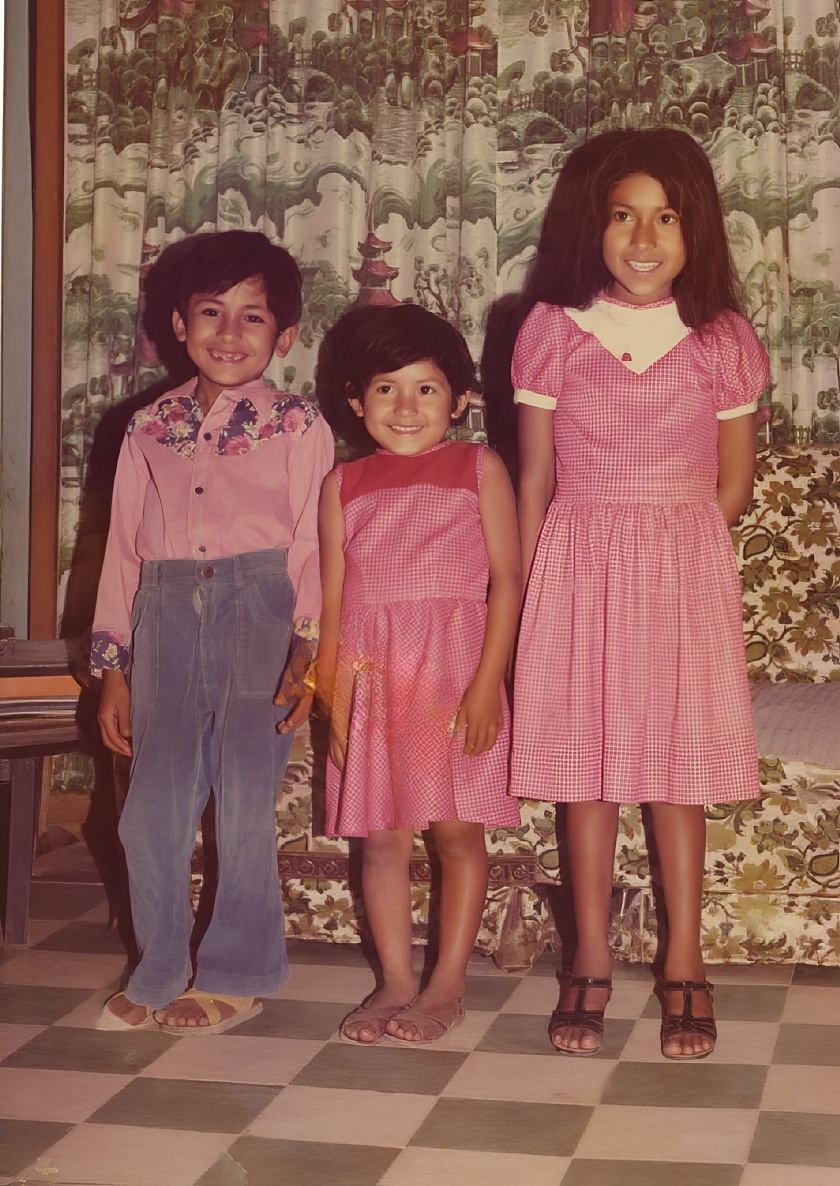
Carlos, Reyna, Mago
ÉLIDA’S HAIR WAS so long, it tumbled down her back like a sparkling black waterfall. Every few days, Abuela Evila washed Élida’s hair with lemon water because, according to her, lemon juice cleans the impurities of the hair and makes it shiny and healthy. In the afternoons, she would fill up a bucket from the water tank, pick a few lemons from the tree, and squeeze the juice into the water.
Mago, Carlos, and I would hide behind a pink oleander bush and watch their ritual through the narrow leaves. Abuela Evila washed Élida’s hair as if she were washing an expensive silk rebozo. Afterwards, Élida would sit under the sun to dry her hair. My grandmother would come out to brush it in small strokes, beginning with the tips and working her way up. She spent half an hour running the comb through Élida’s long hair while we watched.
Our hair was louse-ridden, our abdomens swelled with roundworms, but my grandmother didn’t care. “I can be sure that my daughters’ children are really my grandchildren,” Abuela Evila often said to us. “But one can’t trust a daughter-in-law. Who knows what your mother did when no one was looking.”
It was my mother’s bad luck to have been the only daughter-in-law. My father had a brother who died at seven years old. His name was Carlos, and my brother inherited his name. My grandfather would take Tío Carlos to the fields to work, and since they left very early in the morning, Tío Carlos would be too sleepy to stay awake during the ride to the fields. My grandfather would tie him to the horse to keep him from falling. One day, the horse lost its footing and fell, crushing my uncle beneath it.
But my uncle’s death didn’t save my father from the fields. When he was in third grade, he left school to harvest crops alongside my grandfather. If only Tío Carlos had lived and married, my mother would have had an ally, and we would have had cousins to share the burden of my grandmother’s mistrust.

“Your mother is not coming back for you,” Élida said to us one afternoon while lying in the sun to let her hair dry after Abuela Evila’s lemon treatment. Mago and I were scrubbing our dirty clothes on the washing stone. “Now that she’s got a job and is making dollars, she won’t want to come back, believe me.”
Three weeks before, Mami told us she got a job at a garment factory where she worked all day trimming loose threads off clothes. She said she was finally going to help Papi save money for the house and promised to send us money for Abuela Evila to buy us shoes and clothes. We couldn’t tell Mami not to bother, that the money they sent disappeared by the time my grandmother made it home from the bank. My grandmother hovered above us while we talked on the phone, and if we said anything bad about her, she would spank us afterward.
“She’ll be back. I know she will,” Mago told Élida. In the two and a half months we’d been there, my parents had called us every other weekend, but Mami had yet to send us the letters she promised she would write. But every time she called, Mago would be sure to remind her of her promise—that she would return within the year.
“Don’t lie to yourself,” Élida said. “They’re going to forget all about you, you’ll see. You and your brother and sister are always going to be Los Huerfanitos.”
“Speak for yourself. It’s your mother who’s not coming back,” Mago said. “Doesn’t she have another child, over there in El Otro Lado?”
At being reminded of her American brother, Élida looked away. Abuela Evila came out of the house carrying a large plastic comb. She sat behind Élida and combed into shiny black silk her long hair that smelled of lemonade. Élida was quiet, and she didn’t answer Abuela Evila when she asked her what was wrong.

An hour later, Élida was back in the patio. She lay down on the hammock and watched us do our chores. Mago swept the ground, and I watered Abuela Evila’s pots of vinca and geranium on the edges of the water tank. Carlos was in the backyard clearing the brush, a chore my grandfather had given him. As always, Élida didn’t have to do any work.
She rocked herself on the hammock eating a mango on a stick she had bought at Don Bartolo’s store. It was a beautiful mango cut to look like a flower. Its yellow flesh was sprinkled with red chili powder. My mouth watered at seeing her take a big bite. Élida was always eating goodies she would buy with the money our grandmother gave her, and she never shared them with us. But when our other grandmother, Abuelita Chinta, would visit, bringing us oranges, cajeta, or lollipops, we had to share them with Élida or Abuela Evila would take them away.
“My mother loves me,” Élida said. “That’s why she sends me everything I ask her for. That’s why she writes to me.”
“¡Ya cállate, marrana!” Mago said. She turned the broom to face Élida and started to sweep toward her.
“¡Pinche huérfana!” Élida yelled, scrambling to get away from the cloud of dust Mago had just sent her way. “¡Pinche piojosa!”
“So what if I have lice?” Mago said. “And if you aren’t careful, I’ll give them to you, and we’ll see what happens to all that hair of yours.” Mago pulled me to her and started parting my hair. “¡Mira, mira, un piojo!” she said, holding an imaginary louse toward Élida.
“¡Abuelita! ¡Abuelita!” Élida yelled, her eyes opened wide with fear. She ran into the house clutching her thick long braid. Mago and I looked at each other.
“Look what you’ve done. We’re really going to get it now,” I said to Mago.
I thought we were going to get a beating with my grandmother’s wooden spoon, or a branch or a sandal, the usual choices. I would have preferred a beating to what we got.

In the evening, when Tía Emperatriz came home from work, Abuela Evila told her to take care of our lice problem.
“Can’t it wait for the weekend?” Tía Emperatriz asked. “It’s been a long day for me.”
“They’re going to pass their lice on to me, Abuelita,” Élida said, still clutching her braid. “Please, Abuelita.”
“Do as I say,” Abuela Evila said to my aunt.
Tía Emperatriz glanced at Élida, who was smirking behind Abuela Evila’s hunched figure, and I caught a glimpse of anger, a hint of jealousy in my aunt’s eyes. She gave Mago some pesos and sent her down to Don Bartolo’s store to buy lice shampoo and a fine-tooth comb.
“That’s not going to work,” Abuela Evila said. “Get kerosene.”
“But Amá, that’s dangerous,” Tía Emperatriz said.
“Nonsense,” Abuela Evila said. “In my day, there was no better remedy than kerosene.”
The last rays of the sun were gone, and the world became wrapped in darkness. My grandmother turned on the light in the patio, but it didn’t work. There was no electricity that night, so she brought out her candles and set them on the water tank.
When Mago came back with the kerosene, my aunt had us sit down one by one.
“What if that doesn’t work?” Élida asked.
“If the kerosene doesn’t work, I’m shaving off their hair!” Abuela Evila said.
At hearing my grandmother’s words, I stopped squirming. I sat so still I could hear the mosquitoes buzzing around. They bit my legs and arms, but the thought of getting my head shaved kept me from moving. My aunt gently tilted my head all the way back and in the dim candlelight combed my hair with the fine-tooth comb for five minutes. The comb kept getting caught in my curls, and I felt as if needles were digging into my scalp. Tía Emperatriz soaked a towel in kerosene and then wrapped it around my head, making sure every strand of hair was tucked in before tying a plastic bag over my head to keep the towel in place. The smell was overpowering, and I had to struggle not to scratch my scalp, which was throbbing from the sting of the kerosene.
“Now off to bed,” Tía Emperatriz said when she was done, “and stay away from the lit candles in the house.”

That night was long and restless. I wanted to scratch, scratch, scratch. But could not. The overwhelming smell of the kerosene made it almost impossible to breathe. I reached for my towel and pulled on it, not able to bear the pain and the dizziness any longer.
“Leave it alone,” Mago said.
“It hurts so much,” I said. “I need to scratch. I really need to.”
“My scalp feels as if it’s on fire!” Carlos said. “I can’t take it anymore.”
“Don’t do it,” Mago said. “We’ll get our hair chopped off if you ruin it now.”
“I don’t care!” With one swoop of his hand, Carlos pulled off the towel.
Shortly thereafter, when I reached my limit, I did the same.

Abuela Evila was true to her word. The next afternoon, when my grandfather came home from work, she had him take out his razor blade and scissors. Carlos didn’t put up much of a fuss because he was always trying to please my grandfather. His hair was completely shaved off. We ran our hands over his bald head, feeling the stubble tickle our palms. When she saw him, Élida said, “You look like a skeleton.” She was always making fun of him because Carlos was really skinny, except for his bloated abdomen, and now with his head completely bald, he did look like a skeleton. Élida started to sing a song, “La calaca, tilica y flaca. La calaca, tilica y flaca.” I laughed because it was a funny song, and I could picture a skeleton dancing along to it.
“Regina, it’s your turn,” Abuela Evila said.
“Please, Abuelita, no!” I yelled as my grandmother dragged me to the chair. My grandfather hit me on the head with his hand and ordered me to sit still.
“Allá tú si te quieres mover,” he said when I wouldn’t stop. I jerked around, crying and yelling for Mami to come. I hated myself for being so weak the night before when I tore the towel off. My scalp still burned and my head hurt, but it had all been for nothing. I cried for my hair. It was the only beautiful thing I had. Curls so thick, women in the street would stop and touch it and tell Mami, “Qué bonito pelo tiene su hija. She looks like a doll.” Mami would smile with pride.
“Don’t move, Nena, he’s doing a really bad job!” Mago said. But I didn’t listen, and the scissors hissed near my ear. I squirmed even more at watching my curls land on the ground and on my lap, falling one by one like the petals of a flower. Then my grandmother’s chickens came clucking to see what was happening, and they picked up my curls and shook them around, and when they realized they weren’t food, they stepped all over them and dragged them with their feet across the dirt.
In the end, when Abuelo Augurio was done, I ran to my aunt’s dresser mirror and gasped. My hair was as short as a boy’s, and it was so uneven it looked as if one of the cows from the dairy farm down the road had nibbled on it. I looked at Papi’s photo hanging on the wall, right below the small window. I’d seen myself in the mirror enough times to know that his slanted eyes were just like mine. We both had small foreheads, wide cheeks, and a wide nose. And now, we both had short black hair.
“When are you coming back?” I asked the Man Behind the Glass.
I wished we had a picture of Mami. I wanted to tell her that I missed being with her. I missed watching her getting the dirty clothes ready, putting them inside a blanket and tying the corners to make a sack, then throwing the sack on her head. “Vámonos,” she would say, and I walked alongside her to the canal. There I would sit on the washing stone while she scrubbed the clothes and told me stories. If the water was low, she would let me get in. I would chase after the soap bubbles as she dunked the clothes into the water to rinse.
I missed watching her go through her pretty Avon merchandise—smelling the perfumes, trying on the lotions that smelled of springtime—and seeing her face glow with pride after each sale.
I missed going with her to visit Abuelita Chinta, and taking a nap on Abuelita’s bed while they talked. I would fall asleep listening to Mami’s voice and the cooing of Abuelita Chinta’s doves. And at night, I missed snuggling with her on the bed she had slept in with Papi before he left. Mago and I had tried to keep Mami warm so she wouldn’t miss him so much.
Mago came in to tell me it was dinnertime, and I looked at her and hated her because she didn’t get her hair chopped off. She dealt with the stupid itching all night long. Even though her scalp was irritated and blistered, the lice were all dead. She washed her hair twenty times with Tía Emperatriz’s shampoo that smelled of roses, but it still reeked of kerosene. But at least she didn’t look like a boy.
“Leave me alone,” I said.
“Come on, Nena, come and eat.”
My stomach didn’t care that my hair got butchered. It groaned with hunger, and I had no choice but to go out into the kitchen where everyone could see me. Tía Emperatriz, who was at work when the hair cutting took place, gasped at seeing me and said, “Ay, Amá, what did you do to this poor girl?”
Élida said, “What girl? Isn’t that Carlos?” When I glared at her, she laughed and said, “Oops, I thought you were your brother.”

That night, I had a dream about Mami. In my dream she was washing my hair with lemon water and scrubbing it so gently my body shuddered with pleasure. I awoke with such longing that I felt like weeping. And then I realized that Carlos had wet the bed.