August 19
Last night Dad telephoned from Bakersfield to say that today he was coming through Salinas with a load of garlic and wanted to know if I would meet him at the bus station and ride with him to the dehydrator in Gilroy. Would I!
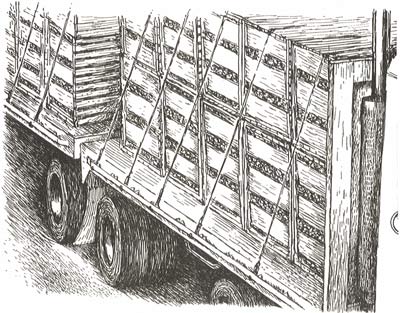
I got up early this morning, whizzed around with the mop at Catering by Katy, exercised Strider, showered, left Strider in Barry’s yard, and caught the bus to Salinas. A couple of minutes after I got there, Dad came barreling up in his tractor. He was hauling two flatbed trailers loaded with wooden bins of garlic stacked two high and tied on with cables.
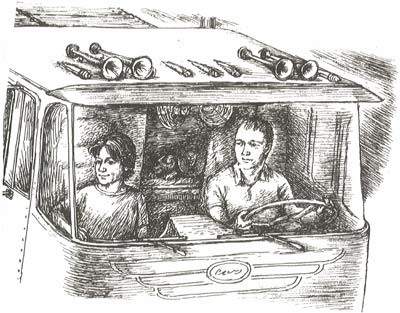
I climbed into the cab beside Dad, who asked, “How’re you doing, Leigh?” Bandit looked up from his bunk behind the seat and went back to sleep.
I told Dad I was doing okay, and we drove off smelling of garlic. An empty Styrofoam cup rolled around the floor of the cab.
Traffic was heavy on 101. There were tractors hauling double gondolas of tomatoes or grapes, and because summer vacation is almost over, tourists with carloads of kids were hurrying toward home.
High in the cab, I had a good view of the Santa Clara Valley. We passed acres of tomatoes, cauliflower, and spinach, a few dying orchards, and beautiful fields of flowers. Zinnias, I think they are called, and marigolds. I asked Dad if the people who raised them got the idea from the Steinbeck story of the man who raised acres of sweet peas. Or maybe it was the other way around. John Steinbeck got the idea for his story from fields like these. Dad said he wouldn’t know, but he did know the flowers were raised for seed, which brought a good price.
Because of the dehydrator, Gilroy is a town you can smell before you see it. Once before when I rode with Dad, the whole town smelled like frying onions, which made me hungry for a hamburger. Today, when the dehydrator was working garlic, Gilroy smelled like Mrs. Brinkerhoff’s kitchen when she makes spaghetti sauce.
As we turned off near the dehydrator, the air was so heavy with the smell of garlic that it made my mouth water. “Do you suppose the garlic smell makes everybody in Gilroy salivate all the time?” I asked. Salivate. That’s a word I had never used before. I usually say drool, but salivate is a good word to save for school. Teachers like large vocabularies.
“Nah,” said Dad. “They’re so used to it they probably can’t even smell it.”
After the garlic was unloaded at the dehydrator, we were so hungry from the smell of garlic that we stopped for pizza for us and water for Bandit. As Dad and I sat facing each other under a wall-mounted TV set showing reruns of boxing matches, Dad asked, “Leigh, you made any plans for the future?” He spoke through a mouthful of pizza. Dad always eats fast. In places like this, he also eats with his cap on. He wouldn’t if Mom were around.
“Oh, not really,” I admitted. The future is something I try not to worry about.
“Just don’t drive a truck like your old man,” Dad told me. “It’s a rough life. Sleeping in the cab and eating in cafés gets old after a few years.”
“I wasn’t planning to,” I said. Now that I took a good look at Dad, he did look tired. Maybe all those country-western songs about truckers are true.
Suddenly Dad asked, “How’s your mother getting along?”
“Okay,” I said. “She works pretty hard.”
“She making any friends?” he asked.
What Dad really wanted to know was, Does she have any men friends? Dad had let me ride with him so he could snoop. This made me so mad I said, “Sure she has friends. They get together to make stuffed animals to sell at craft fairs.” I wasn’t going to squeal on Mom and tell him about Bob from the hospital lab, who sometimes jogs with her and stops by for breakfast, or the paramedic who drives an ambulance, wears a beeper, and takes both of us out to dinner once in a while. Mom always refers to him as the Beeper. Nice guys, both of them, but I don’t think Mom is serious.
Dad was silent, trying to think how he could find out what he wanted to know without letting me know what it was he wanted to know. I was so annoyed I asked, “What about you, Dad? Are you making any friends?”
Dad shot me a look that wasn’t exactly friendly. “Sure,” he said. “I got lots of friends.”
We let it go at that. I didn’t really want to know about the friends Dad makes at truck stops. As we sat facing one another in that booth, it seemed to me that Dad and I didn’t have much to say to each other. Maybe we never did.
Dad made good time back to the Salinas bus stop, but we were quiet most of the way. Without a load, Dad was losing money and was in a hurry to get to Bakersfield to load up more bins of garlic. As I watched him drive off, I felt sad. If he asks questions about Mom, he must be lonely, deep down. I wish I had been nicer.
August 20
My pants are too short! All of them!
When Mom and I were looking over my clothes for school, I got out my pants and discovered they don’t even reach my ankles. They are only good for cutoffs, which are what I have been wearing all summer. I wondered if Mom had noticed the hair I was growing on my legs.
Mom hugged me and said, “I’m going to miss my little boy.” Then we were off to Penney’s for pants. We left Strider shut in the shack.
After pants, we went to the shirt department, where I reminded Mom of my thrift shop shirt which I was saving for school.
She said, “Oh, that shirt,” as if she was both amused and annoyed by it.
As we drove home, I couldn’t forget her remark about missing her little boy. It made me feel guilty. How am I supposed to become a man and be her little boy at the same time?
There was nothing I could do about it, I decided. Besides, I have new pants, hair on my legs, and a great shirt.
By the time we came home, Strider had eaten a corner out of the rug. It’s a good thing it’s our rug, not Mrs. Smerling’s.
September 12
Today I discovered two kinds of people go to high school: those who wear new clothes to show off on the first day, and those who wear their oldest clothes to show they think school is unimportant.
This morning I ran with Strider, mopped Katy’s floor, ran home to shower, and put on my shirt. Then I hurried up to the Brinkerhoffs’ to leave Strider in their yard.
Barry was waiting. “You’re brave,” he said when he saw my shirt.
At the intersection near school we met a boy a little taller than I named Kevin Knight, who was new in junior high last semester. He’s a rich kid. Anyone can tell by his expensive watch, ironed sport shirts, and chinos with creases instead of jeans. Even his haircuts look expensive.
Kevin scowled at me. “That’s my shirt you’re wearing,” he informed me.
“It can’t be,” I said. “I bought it at the thrift shop.” Then I wished I hadn’t mentioned the thrift shop to this rich kid.
“It was my favorite shirt,” said Kevin, “but my mother hated it so much she gave it to the thrift shop before I even had a chance to wear it.”
Some mom. “Why did she have to do that?” I asked, understanding how a new shirt happened to be in the thrift shop.
“She said it was in appalling taste.” Kevin looked angry, and I didn’t blame him.
“Too bad, Kevin,” I said. “It’s my shirt now. I paid for it.”
“Gimme my shirt,” said Kevin and made a grab for it.
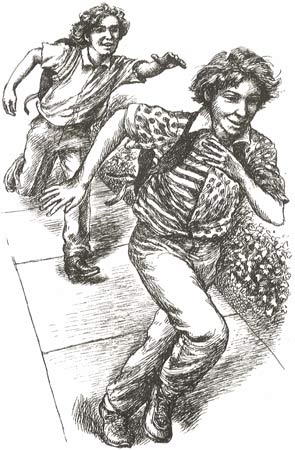
I dodged. Kevin grabbed again. I wasn’t going to lose that shirt, so I ducked and began to run with Kevin chasing me. Our book bags thumped our backs. I reached the school grounds one step ahead of him, ducked, dodged, twisted out of his grasp, and ran some more.
Kids began to yell, “You in the fancy shirt—go!” “Come on, Leigh!” “Get him, Kevin!” “Leigh, go!” I was surprised that so many people knew my name.
I had to stay ahead or lose my shirt in front of the whole school. Pounding down the breeze way past the classroom doors, I looked back to see how close Kevin was and bumped into a teacher who held me by the arm. Maybe he was the principal. “You know the saying, my lad,” he said. “Never look back. Someone might be gaining on you.”
Kevin, panting, caught up. “You better (pant) watch out,” he gasped. “I’ll (pant) get my shirt (pant) back yet.”
I couldn’t resist taunting, “What for? (Pant.) Your mother won’t let you wear it.” That was mean, and I knew it.
“Some shirt,” said the teacher.
The chase was over for today. But tomorrow?
My teachers seem okay, but I’m not sure about my English teacher, Ms. Habis-Jones, who looks unhappy and wears her hair twisted into a knob on top of her head. She ties a white scarf around the knob, which makes her hair look as if it had been wounded and bandaged. When she said that in her classroom we would write, write, write, the guy behind me whispered, “Rah, rah, rah!” She says she will not tolerate non-words such as gonna, kinda, and sorta.
In gym I discovered I am no longer the mediumest boy in my class. I thought if my pants were too short, every other guy’s pants would be too short, too, but it hasn’t worked out that way. When we lined up according to height in gym, I was toward the tall end of the line. Why do we have to line up according to height anyway? Do teachers think we look neater that way? If we lined up according to width, I would be near the front of the line because I am skinny.
September 16
After that first day, I washed my shirt every night, hung it in the shower, smoothed it while it was damp, and put it on again the next morning. Kevin waits every morning, but I keep ahead of him, and we both outrun Barry. Kevin’s legs are longer, but I have more stamina, thanks to Strider. Sometimes he gets close enough to grab my shirt. Then I turn and chase him for a change. It wasn’t long before half the school was watching and cheering. The redheaded girl cheered, too, but she yelled, “Come on, Joseph!” She has forgotten my name, or maybe she means Kevin. Her name is Geneva Weston. I found that out by what are called “discreet inquiries.”
One morning a man who must be the fittest teacher in the school grabbed us both by the arms and said, “I’d like to see you boys harness that energy and turn out for cross-country now and track next spring.” I found out later he was Mr. Kurtz, the track coach. Not being the football type like Barry, I hadn’t thought much about sports before. Running makes me feel good, but I don’t like to run where I can trip in gopher holes, so I don’t think I’ll go out for cross-country.
September 19
This morning Mom said, “Please, Leigh, wear a different shirt today.”
“Why?” I asked. “What’s wrong with this one?” I don’t like Mom telling me what to do. I’m not a little kid anymore. My pants proved that.
“No real reason,” she said. “Just a change of scene.”
Since she wasn’t giving me a direct order, I decided to go along with her. Besides, I don’t want to wear out my shirt. It is valuable because it stands for my not being a wimp.
When Barry and I met Kevin, he demanded, “Where’s my shirt?”
“In my closet,” I told him. Out of habit, we began to run, not really chasing, just running. Barry was able to keep up, which was good. I hadn’t liked leaving Barry behind while I defended my honor.
At school, kids began to tease me: “Hey, look! Leigh has a clean shirt.” This didn’t bother me. I know my shirt is always clean.
When I was about to enter my math room, the redheaded girl came down the breezeway. “Hi, Joseph,” she said. “What happened to your coat of many colors?”
Geneva hadn’t forgotten my name. She was referring to the Bible story about Joseph and his coat of many colors I learned about in Sunday school when we lived in Bakersfield.
“My shirt needs a rest,” I told her and ducked into my classroom because I didn’t know what else to say. I didn’t learn much math because I thought about the girl instead of algebra equations. Her hair isn’t really red, and calling her carrot-top would be inaccurate. I tried to think of the right word. Rust? Orange? Chestnut? Copper? None seemed right.
After class Mr. Gray, who seems to have years of chalk dust ground into him, stopped me and said, “Leigh, you’d better stop day-dreaming and pay attention in class.” He was right. Mom said if my grades dropped, the TV set would have to go.
September 21
Lots of Many things have happened lately. (I guess you can call that a topic sentence. My English teacher is enthusiastic about topic sentences.) The most important thing event happened last night, which was Mom’s night off. We were watching the Olympics on TV when the phone rang. I answered because I was closest. To my surprise, Dad was on the line. For a second I thought about how I used to long for Dad to call, and now I was thinking about how great athletes from all over the world looked marching into the stadium. “Oh, hi, Dad,” I said. “Where are you?”
“In Cholame.” He sounded worried. “Is your mother there?”
Mom took the telephone. “Hi, Bill,” she said. “This is a surprise.”
While she listened, I wondered why Dad was worrying in Cholame, which is just a wide place in the road in a dusty valley between Highways 101 and 5.
Finally Mom said, “I’m sorry, Bill. Really sorry.”
I ran my hand over Strider’s rough hair and wondered what she was sorry about. She soon told me. The transmission of Dad’s tractor had broken down. He was waiting for a tow truck to tow him into Paso Robles, where he will have to wait for a new transmission to be sent up from L.A. First he had to wait for another tractor to haul his load of tomatoes to the soup plant. Even though tomatoes are grown for a long shelf life, they rot fast in the sun.
“A transmission means big bucks,” I told Mom. “And if those tomatoes don’t reach the loading dock on schedule, Dad is in money trouble.”
“Don’t I know it?” said Mom. “And the tractor isn’t even paid for. Your father took out a six-year loan to buy it, and if he gets more than two months behind in payments, the bank will take it.” She sounded so sad and so discouraged I didn’t know what to say, so I slid down on the floor and hugged Strider, who laid his nose against my neck. I continued to watch the Olympics, but my thoughts were in Cholame.
September 24
Mom and I haven’t been getting along as well as we used to. Maybe we are both worried about Dad, or maybe this shack is so small we are getting in each other’s hair. Even though I outgrew my pants, she forgets I’m not a little kid any longer. She is always after me about something, especially about taking our washing to the laundromat, a job I hate and postpone until our laundry practically ferments. She says doing what is expected of me without complaining is a sign of maturity. Yeah, yeah. What about longer pants as a sign of maturity?
If some landlord ever had an attack of kindness and rented us a two-bedroom apartment, it might have a laundry room in the basement, where the whole world couldn’t see me with our washing.
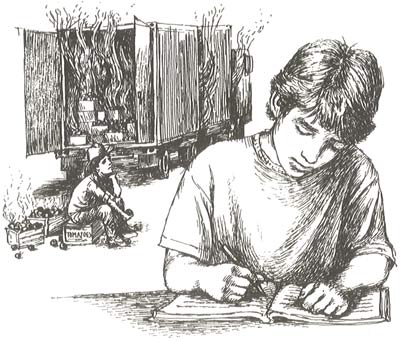
I admire Mom, even when she’s mad at me, and I know she loves me. I’m not so sure about Dad, who never gets mad at me. Maybe he doesn’t care enough. We haven’t heard from him since he called about his breakdown. I picture him sitting alone on a dusty road beside a double trailer-load of tomatoes beginning to smell like old catsup.
September 26
Today was a real shocker. This evening, while Mom was at work and I was studying, Dad telephoned with more news. He has lost his rig! After he had the tractor transmission replaced, he had to admit he couldn’t pay for it until after the tomato season and that he was a month behind in his payments to the bank. The repair people kept the keys, settled with the bank, and now they have the tractor and Dad doesn’t. Boom! Just like that.
Now all Dad has to drive is a beat-up pickup truck.
He towed his house-trailer he had used as home base from Bakersfield to Salinas, where he has a temporary job pumping gas until something better turns up. He said he wanted to be closer to us, something I never expected to hear him say. Nothing was said about support payments, and it wasn’t the time to ask. He sounded so discouraged and sort of ashamed that I feel terrible.
Dad without his rig! The first time I saw him drive it, I thought he was the biggest, strongest man in the world, and nothing could ever happen to him.
September 30
In English we finished studying The Rime of the Ancient Mariner, about an old sailor who corners a wedding guest and makes him listen to a long story about shooting an albatross, thereby placing a curse on his ship. It was a pretty good poem except Ms. Habis-Jones made us pick it to pieces.
Today she said, “Now we are going to write, write, write.”
The boy behind me whispered, “Rah, rah, rah.” She glared.
At first I thought she was going to make us write essays on such topics as the mariner’s motivation in shooting the albatross. Maybe she doesn’t really like the poem because, instead of some bird-related treatise, she told us to write a paragraph on any subject and to pay special attention to the topic sentence.
I thought about The Rime of the Ancient Mariner being written as if the old sailor were telling it. I also thought about gonna and sorta and all the words Ms. Habis-Jones said were not acceptable in her classroom. This made me want to use them. There is something about Ms. Habis-Jones that makes me feel ornery. Since Dad lost his rig, I feel ornery to the nth degree, as we say in algebra, about almost anything.
I wrote, “The old man said to the stranger, ‘I gotcha cornered, and I’m gonna tell ya about my dog. Ya gotta listen even if ya don’t wanna. My dog’s coat is sorta rough, but his ears are kinda soft. He knows howta heel. His eyes say, Gimme your attention, gimme your love, gimme a bone. Whatcha think of that? When I walk him, he always hasta lift his leg. Ya oughta see my dog.’ The stranger said, ‘Lemme go. I don’t care aboucher dog.’”
I had fun writing the paragraph and thought it had a good topic sentence.
Ms. Habis-Jones, who was patrolling the aisles like a guard, stopped at my desk to read over my shoulder. Then she picked up my paper and read it to the class, who laughed. She asked, “Class, what is wrong with this paragraph?”
One of those generic goody-goody girls raised her hand. “Leigh used improper words such as gonna and sorta.”
“That is correct,” said old Wounded-hair, who always speaks in complete sentences. “Leigh, what words should you have used?”
I tried to argue. “My paragraph is spoken. The people speak that way, so the words I used are correct.”
Ms. Wounded-hair dropped my paper on my desk and said, “At the beginning of the semester I said I would not tolerate improper words in this classroom. Rewrite your paper correctly.”
“But that will make it incorrect,” I said, still trying to argue. “I was writing about people who don’t speak correctly.”
Ms. Wounded-hair looked annoyed. “Leigh, you need to improve your attitude,” she informed me. I suppose she has the right to lay down rules for her class. She loves rules. The more the better. She would probably tell Samuel Taylor Coleridge to improve his attitude because he had his Ancient Mariner speak words like o’ertaking and ne’er, but I didn’t say so. You can’t argue with some teachers. If she were grading his poem, she would put a red check over Rime because he didn’t spell it Rhyme. Then she would mark his paper C—.