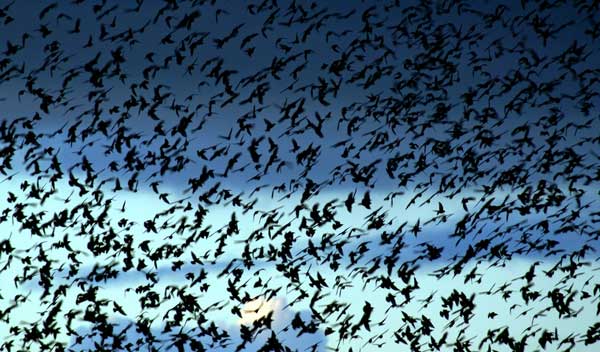
When dinner was over and his wife was washing up, Nat switched on the one o’clock news. The same announcement was repeated, the one which she had taken down during the morning, but the news bulletin enlarged upon it. “The flocks of birds have caused dislocation in all areas,” read the announcer, “and in London the sky was so dense at ten o’clock this morning that it seemed as if the city was covered by a vast black cloud.
“The birds settled on rooftops, on window ledges, and on chimneys. The species included blackbird, thrush, the common house sparrow, and, as might be expected in the metropolis, a vast quantity of pigeons and starlings and that frequenter of the London river, the black-headed gull. The sight has been so unusual that traffic came to a standstill in many thoroughfares, work was abandoned in shops and offices, and the streets and pavements were crowded with people standing about to watch the birds.”
Various incidents were recounted, the suspected reason of cold and hunger stated again, and warnings to householders repeated. The announcer’s voice was smooth and suave. Nat had the impression that this man, in particular, treated the whole business as he would an elaborate joke. There would be others like him, hundreds of them, who did not know what it was to struggle in darkness with a flock of birds. There would be parties tonight in London, like the ones they gave on election nights. People standing about, shouting and laughing, getting drunk. “Come and watch the birds!”
Nat switched off the wireless. He got up and started work on the kitchen windows. His wife watched him, young Johnny at her heels.
“What, boards for down here too?” she said. “Why, I’ll have to light up before three o’clock. I see no call for boards down here.”
“Better be sure than sorry,” answered Nat. “I’m not going to take any chances.”
“What they ought to do,” she said, “is to call the Army out and shoot the birds. That would soon scare them off.”
“Let them try,” said Nat. “How’d they set about it?”
“They have the Army to the docks,” she answered, “when the dockers strike. The soldiers go down and unload the ships.”
“Yes,” said Nat, “and the population of London is eight million or more. Think of all the buildings, all the flats and houses. Do you think they’ve enough soldiers to go around shooting birds from every roof?”
“I don’t know. But something should be done. They ought to do something.”
Nat thought to himself that “they” were no doubt considering the problem at that very moment, but whatever “they” decided to do in London and the big cities would not help the people here, three hundred miles away. Each householder must look after his own.
“How are we off for food?” he said.
“Now, Nat, whatever next?”
“Never mind. What have you got in the larder?”
“It’s shopping day tomorrow, you know that. I don’t keep uncooked food hanging about; it goes off. Butcher doesn’t call till the day after. But I can bring back something when I go in tomorrow.”
Nat did not want to scare her. He thought it possible that she might not go to town tomorrow. He looked in the larder for himself and in the cupboard where she kept her tins. They would do for a couple of days. Bread was low.
“What about the baker?”
“He comes tomorrow too.”
He saw she had flour. If the baker did not call she had enough to bake one loaf.
“We’d be better off in the old days,” he said, “when the women baked twice a week, and had pilchards7 salted, and there was food for a family to last a siege, if need be.”
“I’ve tried the children with tinned fish; they don’t like it,” she said.
Nat went on hammering the boards across the kitchen windows. Candles. They were low in candles too. That must be another thing she meant to buy tomorrow. Well, it could not be helped. They must go early to bed tonight. That was, if . . .
He got up and went out of the back door and stood in the garden, looking down toward the sea. There had been no sun all day, and now, at barely three o’clock, a kind of darkness had already come, the sky sullen, heavy, colorless like salt. He could hear the vicious sea drumming on the rocks. He walked down the path, halfway to the beach. And then he stopped. He could see the tide had turned. The rock that had shown in midmorning was now covered, but it was not the sea that held his eyes. The gulls had risen. They were circling, hundreds of them, thousands of them, lifting their wings against the wind. It was the gulls that made the darkening of the sky. And they were silent. They made not a sound. They just went on soaring and circling, rising, falling, trying their strength against the wind.
Nat turned. He ran up the path, back to the cottage.
“I’m going for Jill,” he said. “I’ll wait for her at the bus stop.”
“What’s the matter?” asked his wife. “You’ve gone quite white.”
“Keep Johnny inside,” he said. “Keep the door shut. Light up now, and draw the curtains.”
“It’s only just gone three,” she said.
“Never mind. Do what I tell you.”
He looked inside the toolshed outside the back door. Nothing there of much use. A spade was too heavy, and a fork no good. He took the hoe. It was the only possible tool, and light enough to carry.
He started walking up the lane to the bus stop and now and again glanced back over his shoulder.
The gulls had risen higher now; their circles were broader, wider; they were spreading out in huge formation across the sky.
He hurried on; although he knew the bus would not come to the top of the hill before four o’clock, he had to hurry. He passed no one on the way. He was glad of this. No time to stop and chatter.
At the top of the hill he waited. He was much too soon. There was half an hour still to go. The east wind came whipping across the fields from the higher ground. He stamped his feet and blew upon his hands. In the distance he could see the clay hills, white and clean, against the heavy pallor of the sky. Something black rose from behind them, like a smudge at first, then widening, becoming deeper, and the smudge became a cloud, and the cloud divided again into five other clouds, spreading north, east, south, and west, and they were not clouds at all; they were birds. He watched them travel across the sky, and as one section passed overhead, within two or three hundred feet of him, he knew, from their speed, they were bound inland, upcountry; they had no business with the people here on the peninsula. They were rooks, crows, jackdaws, magpies, jays, all birds that usually preyed upon the smaller species; but this afternoon they were bound on some other mission.
“They’ve been given the towns,” thought Nat; “they know what they have to do. We don’t matter so much here. The gulls will serve for us. The others go to the towns.”
He went to the call box, stepped inside, and lifted the receiver. The exchange would do. They would pass the message on.
“I’m speaking from the highway,” he said, “by the bus stop. I want to report large formations of birds traveling upcountry. The gulls are also forming in the bay.”
“All right,” answered the voice, laconic, weary.
“You’ll be sure and pass this message on to the proper quarter?”
“Yes . . . yes . . .” Impatient now, fed up. The buzzing note resumed.
“She’s another,” thought Nat, “she doesn’t care. Maybe she’s had to answer calls all day. She hopes to go to the pictures tonight. She’ll squeeze some fellow’s hand and point up at the sky and say ‘Look at all them birds!’ She doesn’t care.”
The bus came lumbering up the hill. Jill climbed out, and three or four other children. The bus went on toward the town.
“What’s the hoe for, Dad?”
They crowded around him, laughing, pointing.
“I just brought it along,” he said. “Come on now, let’s get home. It’s cold, no hanging about. Here, you. I’ll watch you across the fields, see how fast you can run.”
He was speaking to Jill’s companions, who came from different families, living in the council houses. A shortcut would take them to the cottages.
“We want to play a bit in the lane,” said one of them.
“No, you don’t. You go off home or I’ll tell your mammy.”
They whispered to one another, round-eyed, then scuttled off across the fields. Jill stared at her father, her mouth sullen.
“We always play in the lane,” she said.
“Not tonight, you don’t,” he said. “Come on now, no dawdling.”
He could see the gulls now, circling the fields, coming in toward the land. Still silent. Still no sound.
“Look, Dad, look over there, look at all the gulls.”
“Yes. Hurry, now.”
“Where are they flying to? Where are they going?”
“Upcountry, I dare say. Where it’s warmer.”
He seized her hand and dragged her after him along the lane.
“Don’t go so fast. I can’t keep up.”
The gulls were copying the rooks and crows. They were spreading out in formation across the sky. They headed, in bands of thousands, to the four compass points.
“Dad, what is it? What are the gulls doing?”
They were not intent upon their flight, as the crows, as the jackdaws had been. They still circled overhead. Nor did they fly so high. It was as though they waited upon some signal. As though some decision had yet to be given. The order was not clear.
“Do you want me to carry you, Jill? Here, come pick-a-back.”
This way he might put on speed; but he was wrong. Jill was heavy. She kept slipping. And she was crying too. His sense of urgency, of fear, had communicated itself to the child.
“I wish the gulls would go away. I don’t like them. They’re coming closer to the lane.”
He put her down again. He started running, swinging Jill after him. As they went past the farm turning, he saw the farmer backing his car out of the garage. Nat called to him.
“Can you give us a lift?” he said.
“What’s that?”
Mr. Trigg turned in the driving seat and stared at them. Then a smile came to his cheerful, rubicund face.
“It looks as though we’re in for some fun,” he said. “Have you seen the gulls? Jim and I are going to take a crack at them. Everyone’s gone bird crazy, talking of nothing else. I hear you were troubled in the night. Want a gun?”
Nat shook his head.
The small car was packed. There was just room for Jill, if she crouched on top of petrol tins on the back seat.
“I don’t want a gun,” said Nat, “but I’d be obliged if you’d run Jill home. She’s scared of the birds.”
He spoke briefly. He did not want to talk in front of Jill.
“OK,” said the farmer, “I’ll take her home. Why don’t you stop behind and join the shooting match? We’ll make the feathers fly.”
Jill climbed in, and turning the car, the driver sped up the lane. Nat followed after. Trigg must be crazy. What use was a gun against a sky of birds?
Now Nat was not responsible for Jill, he had time to look about him. The birds were circling still above the fields. Mostly herring gull, but the black-backed gull amongst them. Usually they kept apart. Now they were united. Some bond had brought them together. It was the black-backed gull that attacked the smaller birds, and even newborn lambs, so he’d heard. He’d never seen it done. He remembered this now, though, looking above him in the sky. They were coming in toward the farm. They were circling lower in the sky, and the black-backed gulls were to the front, the black-backed gulls were leading. The farm, then, was their target. They were making for the farm.
Nat increased his pace toward his own cottage. He saw the farmer’s car turn and come back along the lane. It drew up beside him with a jerk.
“The kid has run inside,” said the farmer. “Your wife was watching for her. Well, what do you make of it? They’re saying in town the Russians have done it. The Russians have poisoned the birds.”
“How could they do that?” asked Nat.
“Don’t ask me. You know how stories get around. Will you join my shooting match?”
“No, I’ll get along home. The wife will be worried else.”
“My missus says if you could eat gull there’d be some sense in it,” said Trigg. “We’d have roast gull, baked gull, and pickle ’em into the bargain. You wait until I let off a few barrels into the brutes. That’ll scare ’em.”
“Have you boarded your windows?” asked Nat.
“No. Lot of nonsense. They like to scare you on the wireless. I’ve had more to do today than to go round boarding up my windows.”
“I’d board them now, if I were you.”
“Garn. You’re windy. Like to come to our place to sleep?”
“No, thanks all the same.”
“All right. See you in the morning. Give you a gull breakfast.”
The farmer grinned and turned his car to the farm entrance.
Nat hurried on. Past the little wood, past the old barn, and then across the stile to the remaining field.
As he jumped the stile he heard the whir of wings. A black-backed gull dived down at him from the sky, missed, swerved in flight, and rose to dive again. In a moment it was joined by others, six, seven, a dozen, black-backed and herring mixed. Nat dropped his hoe. The hoe was useless. Covering his head with his arms, he ran toward the cottage. They kept coming at him from the air, silent save for the beating wings. The terrible, fluttering wings. He could feel the blood on his hands, his wrists, his neck. Each stab of a swooping beak tore his flesh. If only he could keep them from his eyes. Nothing else mattered. He must keep them from his eyes. They had not learned yet how to cling to a shoulder, how to rip clothing, how to dive in mass upon the head, upon the body. But with each dive, with each attack, they became bolder. And they had no thought for themselves. When they dived low and missed, they crashed, bruised and broken, on the ground. As Nat ran he stumbled, kicking their spent bodies in front of him.
He found the door; he hammered upon it with his bleeding hands. Because of the boarded windows no light shone. Everything was dark.
“Let me in,” he shouted, “it’s Nat. Let me in.”
He shouted loud to make himself heard above the whir of the gulls’ wings.
Then he saw the gannet, poised for the dive, above him in the sky. The gulls circled, retired, soared, one after another, against the wind. Only the gannet remained. One single gannet above him in the sky. The wings folded suddenly to its body. It dropped like a stone. Nat screamed, and the door opened. He stumbled across the threshold, and his wife threw her weight against the door.
They heard the thud of the gannet as it fell.
His wife dressed his wounds. They were not deep. The backs of his hands had suffered most, and his wrists. Had he not worn a cap they would have reached his head. As to the gannet . . . the gannet could have split his skull.
The children were crying, of course. They had seen the blood on their father’s hands.
“It’s all right now,” he told them. “I’m not hurt. Just a few scratches. You play with Johnny, Jill. Mammy will wash these cuts.”
He half shut the door to the scullery so that they could not see. His wife was ashen. She began running water from the sink.
“I saw them overhead,” she whispered. “They began collecting just as Jill ran in with Mr. Trigg. I shut the door fast, and it jammed. That’s why I couldn’t open it at once when you came.”
“Thank God they waited for me,” he said. “Jill would have fallen at once. One bird alone would have done it.”
Furtively, so as not to alarm the children, they whispered together as she bandaged his hands and the back of his neck.
“They’re flying inland,” he said, “thousands of them. Rooks, crows, all the bigger birds. I saw them from the bus stop. They’re making for the towns.”
“But what can they do, Nat?”
“They’ll attack. Go for everyone out in the streets. Then they’ll try the windows, the chimneys.”
“Why don’t the authorities do something? Why don’t they get the Army, get machine guns, anything?"
“There’s been no time. Nobody’s prepared. We’ll hear what they have to say on the six o’clock news.”
Nat went back into the kitchen, followed by his wife. Johnny was playing quietly on the floor. Only Jill looked anxious.
“I can hear the birds,” she said. “Listen, Dad.”
Nat listened. Muffled sounds came from the windows, from the door. Wings brushing the surface, sliding, scraping, seeking a way of entry. The sound of many bodies, pressed together, shuffling on the sills. Now and again came a thud, a crash, as some bird dived and fell. “Some of them will kill themselves that way,” he thought, “but not enough. Never enough.”
“All right,” he said aloud. “I’ve got boards over the windows, Jill. The birds can’t get in.”
He went and examined all the windows. His work had been thorough. Every gap was closed. He would make extra certain, however. He found wedges, pieces of old tin, strips of wood and metal, and fastened them at the sides to reinforce the boards. His hammering helped to deafen the sound of the birds, the shuffling, the tapping, and more ominous—he did not want his wife or the children to hear it—the splinter of cracked glass.
“Turn on the wireless,” he said. “Let’s have the wireless.”
This would drown the sound also. He went upstairs to the bedrooms and reinforced the windows there. Now he could hear the birds on the roof, the scraping of claws, a sliding, jostling sound.
He decided they must sleep in the kitchen, keep up the fire, bring down the mattresses, and lay them out on the floor. He was afraid of the bedroom chimneys. The boards he had placed at the chimney bases might give way. In the kitchen they would be safe because of the fire. He would have to make a joke of it. Pretend to the children they were playing at camp. If the worst happened, and the birds forced an entry down the bedroom chimneys, it would be hours, days perhaps, before they could break down the doors. The birds would be imprisoned in the bedrooms. They could do no harm there. Crowded together, they would stifle and die.
He began to bring the mattresses downstairs. At the sight of them his wife’s eyes widened in apprehension. She thought the birds had already broken in upstairs.
“All right,” he said cheerfully, “we’ll all sleep together in the kitchen tonight. More cozy here by the fire. Then we shan’t be worried by those silly old birds tapping at the windows.”
He made the children help him rearrange the furniture, and he took the precaution of moving the dresser, with his wife’s help, across the window. It fitted well. It was an added safeguard. The mattresses could now be laid, one beside the other, against the wall where the dresser had stood.
“We’re safe enough now,” he thought. “We’re snug and tight, like an air-raid shelter. We can hold out. It’s just the food that worries me. Food, and coal for the fire. We’ve enough for two or three days, not more. By that time . . .”
No use thinking ahead as far as that. And they’d be giving directions on the wireless. People would be told what to do. And now, in the midst of many problems, he realized that it was dance music only, coming over the air. Not Children’s Hour, as it should have been. He glanced at the dial. Yes, they were on the Home Service all right. Dance records. He switched to the Light program. He knew the reason. The usual programs had been abandoned. This only happened at exceptional times. Elections and such. He tried to remember if it had happened in the war, during the heavy raids on London. But of course. The BBC10 was not stationed in London during the war. The programs were broadcast from other, temporary quarters. “We’re better off here,” he thought; “we’re better off here in the kitchen, with the windows and the doors boarded, than they are up in the towns. Thank God we’re not in the towns.”
At six o’clock the records ceased. The time signal was given. No matter if it scared the children, he must hear the news. There was a pause after the pips.11 Then the announcer spoke. His voice was solemn, grave. Quite different from midday.
“This is London,” he said. “A national emergency was proclaimed at four o’clock this afternoon. Measures are being taken to safeguard the lives and property of the population, but it must be understood that these are not easy to effect immediately, owing to the unforeseen and unparalleled nature of the present crisis. Every householder must take precautions to his own building, and where several people live together, as in flats and apartments, they must unite to do the utmost they can to prevent entry. It is absolutely imperative that every individual stay indoors tonight and that no one at all remain on the streets or roads or anywhere outdoors. The birds, in vast numbers, are attacking anyone on sight and have already begun an assault upon buildings; but these, with due care, should be impenetrable. The population is asked to remain calm and not to panic. Owing to the exceptional nature of the emergency, there will be no further transmission from any broadcasting station until 7 A.M. tomorrow.”
They played the national anthem. Nothing more happened. Nat switched off the set. He looked at his wife. She stared back at him
“What’s it mean?” said Jill. “What did the news say?”
“There won’t be any more programs tonight,” said Nat. “There’s been a breakdown at the BBC.”
“Is it the birds?” asked Jill. “Have the birds done it?”
“No,” said Nat, “it’s just that everyone’s very busy, and then of course they have to get rid of the birds, messing everything up, in the towns. Well, we can manage without the wireless for one evening.”
“I wish we had a gramophone,” said Jill; “that would be better than nothing.”
She had her face turned to the dresser backed against the windows. Try as they did to ignore it, they were all aware of the shuffling, the stabbing, the persistent beating and sweeping of wings.
“We’ll have supper early,” suggested Nat, “something for a treat. Ask Mammy. Toasted cheese, eh? Something we all like?”
He winked and nodded at his wife. He wanted the look of dread, of apprehension, to go from Jill’s face.
He helped with the supper, whistling, singing, making as much clatter as he could, and it seemed to him that the shuffling and the tapping were not so intense as they had been at first. Presently he went up to the bedrooms and listened, and he no longer heard the jostling for place upon the roof.
“They’ve got reasoning powers,” he thought; “they know it’s hard to break in here. They’ll try elsewhere. They won’t waste their time with us.”
Supper passed without incident, and then, when they were clearing away, they heard a new sound, droning, familiar, a sound they all knew and understood.
His wife looked up at him, her face alight. “It’s planes,” she said; “they’re sending out planes after the birds. That’s what I said they ought to do all along. That will get them. Isn’t that gunfire? Can’t you hear guns?”
It might be gunfire out at sea. Nat could not tell. Big naval guns might have an effect upon the gulls out at sea, but the gulls were inland now. The guns couldn’t shell the shore because of the population.
“It’s good, isn’t it,” said his wife, “to hear the planes?” And Jill, catching her enthusiasm, jumped up and down with Johnny. “The planes will get the birds. The planes will shoot them.”
Just then they heard a crash about two miles distant, followed by a second, then a third. The droning became more distant, passed away out to sea.
“What was that?” asked his wife. “Were they dropping bombs on the birds?”
“I don’t know,” answered Nat. “I don’t think so.”
He did not want to tell her that the sound they had heard was the crashing of aircraft. It was, he had no doubt, a venture on the part of the authorities to send out reconnaissance forces, but they might have known the venture was suicidal. What could aircraft do against birds that flung themselves to death against propeller and fuselage but hurtle to the ground themselves? This was being tried now, he supposed, over the whole country. And at a cost. Someone high up had lost his head.
“Where have the planes gone, Dad?” asked Jill.
“Back to base,” he said. “Come on, now, time to tuck down for bed.”
It kept his wife occupied, undressing the children before the fire, seeing to the bedding, one thing and another, while he went round the cottage again, making sure that nothing had worked loose. There was no further drone of aircraft, and the naval guns had ceased. “Waste of life and effort,” Nat said to himself. “We can’t destroy enough of them that way. Cost too heavy. There’s always gas. Maybe they’ll try spraying with gas, mustard gas. We’ll be warned first, of course, if they do. There’s one thing, the best brains of the country will be onto it tonight.”
Somehow the thought reassured him. He had a picture of scientists, naturalists, technicians, and all those chaps they called the back-room boys, summoned to a council; they’d be working on the problem now. This was not a job for the government, for the chiefs of staff—they would merely carry out the orders of the scientists.
“They’ll have to be ruthless,” he thought. “Where the trouble’s worst they’ll have to risk more lives if they use gas. All the livestock, too, and the soil—all contaminated. As long as everyone doesn’t panic. That’s the trouble. People panicking, losing their heads. The BBC was right to warn us of that.”
Upstairs in the bedrooms all was quiet. No further scraping and stabbing at the windows. A lull in battle. Forces regrouping. Wasn’t that what they called it in the old wartime bulletins? The wind hadn’t dropped, though. He could still hear it roaring in the chimneys. And the sea breaking down on the shore. Then he remembered the tide. The tide would be on the turn. Maybe the lull in battle was because of the tide. There was some law the birds obeyed, and it was all to do with the east wind and the tide.