NALEDI’S PLAN
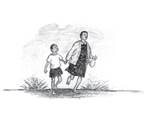
Naledi and Tiro were worried. Their baby sister Dineo was ill, very ill. For three days now, Nono their granny had been trying to cool her fever with damp cloths placed on her little head and body. Mmangwane, their aunty, made her take sips of water, but still their sister lay hot and restless, crying softly at times.
“Can’t we take Dineo to the hospital?” Naledi begged, but Nono said Dineo was much too sick to be carried that far. The only hospital was many miles away, and Naledi also knew they had no money to pay a doctor to visit them. No one in the village had that much money.
“If only Mma was here,” Naledi wished over and over as she and Tiro walked down to the village tap with their empty buckets. She clutched tightly at the coins in her hand.
Each morning the children had to pass the place of graves on their way to buy the day’s water and only last week another baby in the village had died. It was always scary seeing the little graves, but especially this fresh one now.
As they came nearer, Naledi fixed her eyes on the ground ahead, trying not to look, trying not to think. But it was no use. She just couldn’t stop herself thinking of her own little sister being lowered into a hole in the ground.
Finally Naledi could stand it no longer. When they had returned with the water, she called Tiro to the back of the house and spoke bluntly.
“We must get Mma, or Dineo is going to die!”
“But how?” Tiro was bewildered. Their mother worked and lived in Johannesburg, more than 300 kilometres away.
“We can get to the big road and walk,” Naledi replied calmly.
It was the school holidays now, but in term-time it took the children more than an hour to walk to school each day, so they were used to walking. Naledi wasn’t going to let herself think how much longer it would take to get to Johannesburg.
However, Tiro was not so sure.
“But Nono doesn’t want us to worry Mma and I know she won’t let us go!”
“That’s just it,” Naledi retorted quickly. “Nono and Mmangwane keep saying Dineo will be better soon. You heard them talking last night. They say they don’t want to send Mma a telegram and frighten her. But what if they wait and it’s too late?”
Tiro thought for a moment.
“Can’t we send Mma a telegram?”
“How can we if we haven’t the money? And if we borrow some, Nono will hear about it and be very cross with us.”
It was clear that Naledi had made up her mind – and Tiro knew his sister. She was four years older than him, already thirteen, and once she had decided something, that was that.
So Tiro gave up reasoning.
The children went to find Naledi’s friend Poleng, and explained. Poleng was very surprised but agreed to help. She would tell Nono once the children had gone and she also promised to help their granny, bringing the water and doing the other jobs.
“How will you eat on the way?” Poleng asked.
Tiro looked worried, but Naledi was confident.
“Oh, we’ll find something.”
Poleng told them to wait and ran into her house, returning soon with a couple of sweet potatoes and a bottle of water. The children thanked her. She was indeed a good friend.
Before they could go, Naledi had to get the last letter Mma had sent, so they would know where to look for her in the big city. Slipping into the house, Naledi took the letter quietly from the tin without Nono or Mmangwane noticing. Both were busy with Dineo as Naledi slipped out again.
THE ROAD
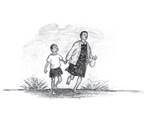
The children walked quickly away from the village. The road was really just a track made by car tyres. Two lines of dusty red earth leading out across the flat dry grassland.
Once at the big tar road, they turned in the direction of the early morning sun, for that was the way to Johannesburg. The steel railway line glinted alongside the road.
“If only we had some money to buy tickets for the train. We don’t have even one cent.” Tiro sighed.
“Never mind. We’ll get there somehow!” Naledi was still confident as they set off eastwards.
The tar road burnt their feet.
“Let’s walk at the side,” Tiro suggested.
The grass was dry and scratchy, but they were used to it. Now and again, a car or a truck roared by, and then the road was quiet again and they were alone. Naledi began to sing the words of her favourite tune and Tiro was soon joining in.
On they walked.
“Can’t we stop and eat?” Tiro was beginning to feel sharp stabs of hunger. But Naledi wanted to go on until they reached the top of the long, low hill ahead.
Their legs slowed down as they began the walk uphill, their bodies feeling heavy. At last they came to the top and flopped down to rest.
Hungrily they ate their sweet potatoes and drank the water. The air was hot and still. Some birds skimmed lightly across the sky as they gazed down at the long road ahead. It stretched into the distance, between fenced-off fields and dry grass, up to another far-off hill.
“Come on! We must get on,” Naledi insisted, pulling herself up quickly.
She could tell that Tiro was already tired, but they couldn’t afford to stop for long. The sun had already passed its midday position and they didn’t seem to have travelled very far.
On they walked, steadily, singing to break the silence.
But in the middle of the afternoon, when the road led into a small town, they stopped singing and began to walk a little faster. They were afraid a policeman might stop them because they were strangers.
Policemen were dangerous. Even in their village they knew that …
The older children at school had made up a song:
“Beware that policeman,
He’ll want to see your ‘pass,
He’ll say it’s not in order,
That day may be your last!”
Grown-ups were always talking about this “pass”. If you wanted to visit some place, the “pass” must allow it. If you wanted to change your job, the “pass” must allow it. It seemed everyone in school knew somebody who had been in trouble over the “pass”.
Naledi and Tiro remembered all too clearly the terrible stories their uncle had told them about a prison farm. One day he had left his “pass” at home and a policeman had stopped him. That was how he got sent to the prison farm.
So, without even speaking, Naledi and Tiro knew the fear in the other’s heart as they walked through the strange town. They longed to look in some of the shop windows, but they did not dare stop. Nervously, they hurried along the main street, until they had left the last house of the town behind them.
ORANGES
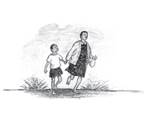
On they walked. The sun was low down now and there was a strong smell of oranges coming from rows and rows of orange trees behind barbed wire fences. As far as they could see there were orange trees with dark green leaves and bright round fruit. Oranges were sweet and wonderful to taste and they didn’t have them often.
The children looked at each other.
“Do you think we could …” Tiro began.
But Naledi was already carefully pushing apart the barbed wire, edging her body through.
“Keep watch!” she ordered Tiro.
She was on tiptoes, stretching for an orange, when they heard, “HEY, YOU!”
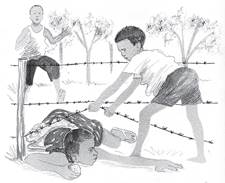
Naledi dropped down, then dashed for the fence. Tiro was holding the wires for her. She tried to scramble through, but it was too late. A hand grasped her and pulled her back.
Naledi looked up and saw a young boy, her own age.
“What are you doing?” he demanded.
He spoke in Tswana, their own language.
“The white farmer could kill you if he sees you. Don’t you know he has a gun to shoot thieves?”
“We’re not thieves. We’ve been walking all day and we’re very hungry. Please don’t call him,” Naledi pleaded.
The boy looked more friendly now and asked where they came from.
So they told him about Dineo and how they were going to Johannesburg. The boy whistled.
“Phew. So far!”
He paused.
“Look. I know a place where you can sleep tonight and where the farmer won’t find you. Stay here and I’ll take you there when it’s dark.”
Naledi and Tiro glanced at each other, still a little nervous.
“Don’t worry. You’ll be safe waiting here. The farmer has gone inside for his supper,” the boy reassured them. Then he grinned. “But if you eat oranges you must hide the peels well or there will be big trouble. We have to pick the fruit, but we’re not allowed to eat it.”
He turned and ran off, calling softly, “See you later.”
“Can we stay here for the night?” Tiro asked.
Naledi wasn’t too sure if they should.
“It can go badly if the farmer finds us. Remember what happened to Poleng’s brother?”
When Poleng’s brother had been caught taking a mielie, the poor boy had been whipped until he couldn’t stand up any more.
Tiro bit his lip.
“But we can leave early in the morning before the farmer is up, can’t we?”
“Well … I expect we must sleep somewhere, or we’ll be too tired to walk tomorrow,” Naledi agreed slowly.
So Tiro slipped through the barbed wire and together they picked some oranges. It seemed a bit safer now that it was getting darker. Four large oranges were enough for Naledi, but Tiro kept on picking and eating more.
“You’ll be sick if you stuff yourself like that,” warned his sister.
Still he took no notice, until suddenly he clutched his tummy.
“Ooooh!” he groaned.
Naledi just said, “What did I tell you? Come on, we must hide the peels.”
With two sharp stones they began to dig a hole. Tiro made odd little grunts from the pain in his tummy, but he dug well even though the ground was hard and dry. After burying the peel and filling up the hole, they searched around for stones and dry leaves to cover over the freshly dug soil.
They sat close together, shivering a little from the night chill. Naledi had begun to wonder if the boy really would return, when they heard the sound of soft running footsteps. The shape in the dark was that of the boy worker.
“Come!” he beckoned, and began to lead the way through rows and rows of orange trees.
They stumbled along, hardly able to see, but at last they came to a shed.
“You’ll be warm with the sacks,” the boy said quietly as he let them in. Then, shyly, he took out a tin plate from under a sack. “I brought you a little pap. I’m sorry but that’s all we get here most days.”
“Thank you, thank you,” Tiro and Naledi whispered.
“Sala sentle,” said the boy as he slipped away in the dark.
“Tsamaya sentle,” came the reply from the shed.