Seven Dead Rats
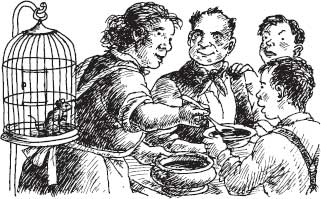
From a birdcage, Mrs Frisby watched the Fitzgibbons eat dinner. There was dinner for her, too — breadcrumbs, cheese, and bits of carrot — on the floor of the cage, along with a small bowl of water. The cage had been occupied until a few months before by a yellow canary named Porgy, who had lived in it for five years and then died of old age.
To get her out from under the colander, Billy had slid a piece of cardboard beneath it, pinching her foot sharply in the process, so that it hurt when she walked. She had been transferred first to a shoebox.
‘Can I keep it?’ Billy had asked his mother.
‘What for? It’s just a field mouse.’
‘For a pet. I like it.’ Billy had tried to look at Mrs Frisby through some holes he had punched in the top of the box, but it was dark inside.
‘I suppose so. For a few days. You’ll have to feed it.’
‘I think I’ll put it in Porgy’s cage. I can’t see it in this box. It must be hungry. It was trying to eat Dragon’s food. Dumb mouse. It might have been killed.’
No one had noticed the small torn piece of paper at first; then Mrs Fitzgibbon had absently picked it up and tossed it into the wastebasket.
A few days! Mrs Frisby felt sick. And after a few days — then what? Would they let her go? Or would Billy plead for a few more? But even if they did set her free — her children were alone; the rats were coming tonight to move her house. Why had Billy picked today, of all days, to sit on the stool? She had not the heart to eat the food that lay on the cage floor. She felt like weeping.
Paul came in for dinner, followed by his father. He looked at her in the cage.
‘Why don’t you let it go?’ he said to Billy. ‘Poor little thing. It’s scared to death.’
‘No it’s not. It’s just not used to the cage.’
‘I bet it will die.’
‘I bet it won’t.’
‘You can’t just put wild animals in cages. You have to catch them when they’re babies.’
‘They do it in zoos.’
‘Yes, but they know more about it. Anyway, a lot of those die, too.’
‘It’s strange that it was in here at all,’ said Mrs Fitzgibbon. ‘I haven’t seen any signs of mice. I didn’t think we had any.’
They sat at the table, and Mrs Fitzgibbon served the stew. It was a long, square-cut farm table, big enough to feed, besides the family, the four hired hands who would be working with Mr Fitzgibbon during the planting and harvesting. The Fitzgibbons sat together around one end of it.
Mrs Frisby’s cage hung from a metal stand in the corner on the opposite side of the room, quite high up, so that the floor where she crouched was above their heads. She could watch them, looking down; but if she retreated to the far side of the cage, they could not see her, nor she them. She kept hoping that Paul would resume the argument with Billy and win it, or at least convince Mr or Mrs Fitzgibbon that they should let her go.
But Paul was now busy eating. So, moving quietly, she crept to the back of the cage. There was a sliding door halfway up the side, which Billy had lifted to put her in. Remembering Nicodemus’s story, she looked at it, wondering if she could climb to it, if she could get it open if she did. Not now, but later, when they had left the kitchen. Maybe. But it looked quite big and heavy.
She thought about her children again. Surely, when Justin had waited a little longer, he would realize that something had gone wrong. He would go and talk to them. But what could he tell them? ‘Children, your mother went into the kitchen with Dragon and she hasn’t come out.’ No. But whatever he said, they would be dreadfully frightened and worried. Poor Cynthia! Poor Timothy — poor all of them.
She had one small satisfaction. Dragon, who had been admitted after she was safely caged, had eaten his bowl of catfood greedily, sleeping powder and all, purring as he licked the last scraps from the bottom.
Billy was looking at the cage.
‘There,’ he cried. ‘It walked. I saw it. I told you it was all right.’ He started up from his chair.
‘Billy, stay in your place and eat your stew,’ said Mrs Fitzgibbon. ‘The mouse can wait.’
‘Speaking of mice,’ said Mr Fitzgibbon, who had driven to town that afternoon, ‘there was quite a stir today at Henderson’s hardware store.’
‘About mice?’
‘No, but nearly. About rats. I went in to order the new linchpin, and there was quite a group there, talking about an odd thing that had happened.
‘It seems that six or seven rats got themselves electrocuted there a few days ago. Very strange. Henderson sells motors — he has a whole shelf of them. The rats, for some reason, had got on the shelf. He says it looked as if they were fooling with one of the motors, trying to move it.’
‘That’s a new one,’ said Paul. ‘Rats stealing motors.’
‘They weren’t really, of course. Anyway, it happened during the night; when he — Henderson — came into the shop in the morning, he tried to turn on the lights, and the fuse was blown. He found the rats all grouped around the motor. It had been left plugged in, though it was turned off. They must have been gnawing at the insulation for some reason — at least that’s what he thinks. They caused a short circuit, and all bunched together like that, the current went through them and killed the lot.’
‘Pretty good kind of a rat trap, I’d say,’ Mrs Fitzgibbon remarked.
Mrs Frisby was now listening to the conversation very closely. Dragon had stretched out on the floor, looking drowsy.
‘Wait,’ said Mr Fitzgibbon. ‘That’s only the beginning. It seems that the local weekly was hard up for news. They heard about it and sent their reporter over.’
‘Fred Smith,’ said Mrs Fitzgibbon.
‘Yes. Fred wrote a little article about it, with a headline, MECHANIZED RATS INVADE HARDWARE STORE. Something like that. Well, it attracted more attention than he expected. The next thing they knew, believe it or not, the federal government got into it. They sent a squad over there from the Public Health Service with a truckload of equipment.’
‘Just on account of seven rats?’ said Billy. ‘They should send the truck over here. We’ve got more than that.’
‘That’s just what I said,’ Mr Fitzgibbon went on. ‘And do you know? They’re going to. I was joking, of course, but the man in charge of the group didn’t take it as a joke at all. He wanted to know where the farm was, how far away, how many acres, what I raised, how many rats I thought there were. He acted really interested. It seems they wanted to examine the dead rats at Henderson’s, but they couldn’t. He’d already sent them to the town dump, and they were incinerated.’
‘I never heard of such a thing,’ said Mrs Fitzgibbon. ‘All that fuss over a few dead rats.’
‘I have,’ said Paul. ‘And I bet I know what they’re after.’
‘What?’
‘They think the rats have rabies. They don’t like to say so because it makes people panicky.’
‘What’s rabies?’ asked Billy.
‘A disease,’ said Mr Fitzgibbon. ‘A very bad one, spread by animals. You know, Paul, I think you’re probably right. That would explain why the Public Health Service is in it. Epidemic control. Anyway, they’re planning to check on the rats all over this area.’
‘Don’t you remember,’ Paul said, ‘a few years ago when everybody had to lock up their dogs? And some people were shooting every dog they saw. That’s why they keep it quiet until they’re sure.
‘And another thing. They taught us in the vet course in school that when an animal starts acting strange, it may be a sign of rabies. Well, chewing electric wires — that’s strange enough.’
‘And they think some rats here might be infected?’ Mrs Fitzgibbon sounded worried.
‘I suppose they must,’ said Mr Fitzgibbon, ‘though they never mentioned rabies at all.’
‘When are they coming?’
‘Day after tomorrow. Saturday morning. The man in charge, a Doctor somebody, said they had some more checking to do in town tomorrow. They’re coming with an extermination truck — cyanide gas, I think.’
‘I can tell them where to look,’ Paul said.
‘Me too,’ said Billy. ‘Under the rosebush.’
‘That’s right,’ said Mr Fitzgibbon. ‘In fact, they’ll probably want to bulldoze that bush out of there. I can do that with the big tractor.’
‘Bulldoze my rosebush?’ said Mrs Fitzgibbon indignantly. ‘They will not!’
‘Look at it this way,’ her husband said. ‘I’ve got to get rid of those rats anyway. I’d already decided to; they’re stealing too much feed — seeds, too, more all the time. If I paid an exterminator to do it, he’d charge a couple of hundred dollars. If the government will do it free, why shouldn’t we let them?’
‘Well,’ said Mrs Fitzgibbon, still not soothed, ‘then you can spend the money to buy me some new rosebushes.’
‘That’s just what I had in mind,’ said Mr Fitzgibbon with a smile. ‘And maybe some lilacs, too.’ Mrs Fitzgibbon had always wanted a lilac bush; they were her favourite shrubs.
Mrs Frisby did not believe at all that it was rabies the men were looking for. She wished Mr Fitzgibbon had been able to remember the name of the ‘Doctor somebody’. And now she had another urgent reason to get out of the cage. Somehow, she had to warn Nicodemus.
Dragon slept on the kitchen floor.
HTML style by Stephen Thomas, University of Adelaide. Modified by Skip for ESL Bits English Language Learning.