CHAPTER TEN
Sometimes I wonder what it would be like if a younger version of myself saw what I’m like in the present day. I used to imagine it in a more heartwarming sense, as in, Yeah, I might not be 100 percent happy right now with my life, but nine-year-old me would be super proud. I bet she didn’t even think that she’d make it this far.
But if nine-year-old me could see what is happening at this very moment, she would have a stroke and die, right there on the spot. She would spontaneously combust like that lady in Ireland in the ’70s, the one in that odd but intriguing photo of a pile of ashes and two burned feet. That’s what generally happens with spontaneous human combustion, although many doctors and scientists disagree about whether it truly exists. The person leaves a foot, or a finger behind, as if to say, I was here, whether you believe in me or not.
Nine-year-old me would feel such a toxic mixture of confusion and pain and shame and fear that her brain would burst into flames out of pure sensory overload.
Seventeen-year-old me doesn’t feel too much of anything. Time moves so slowly that I physically can’t. I can barely hear anything over the pure cacophony of all the blood coursing through my veins. I can see Maeve’s fingernails digging into my skin, leaving pale white crescent moons along my arm. I see her hair whip wildly as she pulls and twists frantically, wondering why I’m standing there and not as freaked out about this as she is.
But I’m not just standing around. My hand is being pulled, fraction of a centimeter by fraction of a centimeter, closer and closer to the generator until it disappears inside completely. The motor eats it alive, its ridges getting caught on my skin and pulling my arm through the tiny gap between the cylinder and the top of the generator. In normal times, this would be bad, but now? Without doctors and hospitals and CVS? It’s so much worse. I didn’t even think that this could be dangerous. I don’t even know how these machines work, let alone how good they are at consuming human hands.
As I watch my hand get eaten alive by this machinery that I was so desperate to fix, I think that maybe I deserve it. Maybe the world finally got fed up with my bullshit. Maybe I’ve gotten so good at burying the pricks of pain that keep me up at night that the universe wants to make sure that I feel constant pain, forever. Who am I to deny the world its justice?
Maeve wraps her arms around my shoulder so tightly that I can barely breathe. I can feel her, even though I can feel nothing else. I can feel the heat of her skin, and I can feel her breath on the back of my neck. She lets go when she’s finally wrestled me free of the machine, stumbling backward and pulling us both onto the ground. We sit there, huffing and puffing and looking at everything except at one another.
In an instant, time returns to its normal speed. And it hurts. In these seconds, I feel everything. Every nerve in my right arm is on fire. The whole thing throbs unforgivingly, and I can feel every heartbeat, every pump of blood, in each dull burst that erupts down my limb.
I don’t want to look at it, because it hurts so badly. I try to choke down the scream that’s erupting from my mouth, but I can’t help it. The sound is feral. The pain overwhelms my brain, stifling any thoughts, any rational function. If my hand feels this bad, I cannot imagine what it might look like. And because looking simply isn’t feasible, I turn to Maeve. I allow her to look for me. I can’t meet her gaze, because it’s latched on to my throbbing, bleeding hand. She refuses to turn away, as if my arm would fall off completely if she even dared to.
I can feel drops of something warm and sticky land on my feet, staining my sandals. I can’t help but glance toward them, watching the red cascade over my ankle and melt into my skin.
Maeve finally pulls her gaze away from my hand. She looks scared. Really scared. Her skin is drained of color. She’s biting her bottom lip so hard that I’m afraid she might start bleeding. I think I’m bleeding enough for the both of us.
All I can think to say is “Holy shit!” which isn’t at all eloquent. I compose myself. “You know I’ve never broken a bone before?” I manage. My voice is quivering and weak. “Never even been to the hospital.” I can barely speak. I can barely breathe.
“You’re delirious,” Maeve says before grabbing my left shoulder. It hurts. My whole body is on fire. Dying over and over again a million times.
I can barely hear Maeve when she says, “Liz, I need to get you inside so we can try to fix this, okay?”
I can barely think, let alone force my feet to move. With Maeve pulling me gently, I manage to hobble inside as my hand sends drips of blood spiraling toward the ground. As we limp toward the store, Maeve continues to speak, her soft voice buzzing in my ear.
“You busted yourself up pretty good, didn’t you?” she mutters. “Genius idea of yours, putting your hand inside machinery. That’s always a recipe for success. Oh no! The power went out! Let me stick my hand inside the fuse box!” I bite my tongue instead of telling her that I didn’t even think that I was doing anything dangerous. She’d probably make some witty comment about my glaring lack of street smarts.
There’s a small sliver of worry lurking within her voice. The feeling catches me so off guard that the only thing I can manage to say is, “I’m dripping on the floor. It’s going to stain.”
“You know, Liz, there are more important things than the floor. There are things that are more important than generators and broken windowpanes and rusty hinges. Like…I don’t know…staying alive?” It’s not a question; it’s a declaration. “I heard of a place down south, in North Carolina, where the government—”
“Is there anything left of the government?” I interject, the words getting trapped between my gritted teeth.
“It’s supposed to be better there. Food and shelter, military grade, all of it. Real safety.”
She sits me down on the stool behind the front counter, the metal seat searing the backs of my thighs. I look up at her, woozy with pain. She doesn’t understand that the two things aren’t mutually exclusive. Generators and staying alive. Windowpanes and survival. They work together. She doesn’t understand that safety isn’t simply the government and food and shelter. It’s so much more than that.
“I don’t know…if there is any place safe,” I manage to choke out. “This is the—” I swallow down another yelp of pain. “Best shot I’ve got. This is—home.”
Either Maeve didn’t hear me, or she’s making a point to ignore my recent declaration. “Do you have a first aid kit?” A sloppy change of topic, but it works.
I nod. I suddenly have a throbbing headache. “It should be…over there.” I point with my good hand. “Right inside that…” My voice trails off, but Maeve seems to understand.
As she turns, I take the opportunity to finally look at my arm and assess the damage the generator did to me. When I do, my stomach drops.
A long, jagged gash runs down the top of my forearm, still bleeding. There are grease marks in scattered lines across my skin, mixing with the deep red. My hand is in even worse shape, knuckles shaved down to what looks like bone. Fingers hang limply off, and no matter how hard I try, I can’t get them to move. I can’t get my hand to move.
I feel something wet well up behind my eyes as my entire world turns on its head.
Maeve returns, holding up a wad of bandages and ripped cloth, clutching them so tightly that her veins bulge around her knuckles. A look of concentration settles onto her face.
“Lift up your arm.”
I do, and it wobbles in the air. Maeve gingerly places her fingers under my forearm, lifting it slightly to glance at the gashes.
“Is it that bad?” I ask, even though I kind of already know the answer. I want to hear her lie to me. I want to believe her.
Maeve shakes her head in response. “It’s bleeding a lot, but I’m going to try wrapping it. Applying some pressure. I’ll wash it out first, but hopefully it doesn’t need stitches, because we do not have the equipment to deal with that right now.”
“Stitches?” I manage. I rack my brain to see if I know of any doctors who are still alive. Have any doctors come to the bookstore? Please, dear god, say they have.
“I guess we could cauterize it if it gets too bad. We don’t want it to get infected, because your little first aid kit definitely doesn’t have the antibiotics to deal with that. Also, why was there so much hand lotion in there?” She’s not talking to me anymore. She’s speaking to distract herself from the present. I understand the feeling.
Maeve throws an old decorative tea towel at me, emblazoned with the phrase I support my local bookstore! The tag is still on it. $15.99.
“Put pressure on the cut. I need to find some water to clean this thing out.” She doesn’t even give me the chance to respond before walking out the back door. She’s halfway up the stairs when I hear her shout, “Don’t bleed out while I’m gone.”
I don’t say anything, my mouth suddenly too dry to speak. I just press the godforsaken tea towel as tightly as possible down on my arm, no matter how much it hurts. I watch as my blood slowly seeps through the fabric, obscuring the letters one by one.
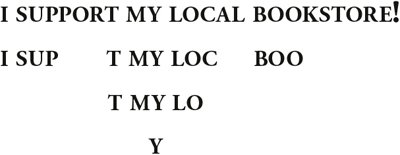
Maeve walks back inside with a metal canteen. The letters on the towel are gone now, maroon overlapping with maroon.
I motion toward the blood-soaked cloth. “I need another towel.”
“Here. Just give me the cloth, and I’ll wash your cut out and bandage you up. Knuckles too.”
I smile weakly and she kneels, carefully pouring what little water she has left over my skin. And it burns. It burns so badly that the feeling floods my brain. My vision clouds, and I start seeing little spots everywhere.
“Where’s the water from?” I manage to ask.
“It’s my personal supply. The last of it.”
I bite my tongue until I’m completely certain that I’m going to bite it off. I bite it so hard that I can feel the blood rising to my head, my vision going from clear to red to black.
CHAPTER ELEVEN
When I open my eyes, Maeve is sitting on the counter, swinging her legs back and forth. Everything still hurts, the pain piercing the back of my brain. It creeps behind my temples, radiating from my fingertips up my nervous system. I’m on fire.
“Welcome back to the land of the living,” she mutters, tucking a piece of hair behind her ear.
The comment strikes me as odd because I wasn’t aware that there was another option, and so I ask, “Am I going to die?” I look down at the gaping slit in my arm, running like a ribbon across my skin and up my hand, like the crevasse in the middle of a geode. The edges of the wound are ragged like that, too, bits of stray flesh tapering off in triangles around the congealed crimson. Beneath it, in the deeper sections, there are patches of pale pink, small hints of the muscle and bone that lie beneath. I look at my skinless hand and admire the tendons stretching from my knuckles to my wrist. It’s like I’m a marionette. At this moment, death seems like an appropriate question.
Maeve pauses, her chest freezing midbreath. I was hoping she’d laugh. I was hoping she’d say of course not and call me a fool, but she doesn’t. Maeve shakes her head. “I don’t know, Liz. How would I know?” She speaks rapidly, each syllable bumping into the next as they make their way out of her mouth. “I don’t know.”
She finally looks me in my eyes, but her glance isn’t honest. She doesn’t seem to believe what she’s saying.
“You seem like you’d know that sort of thing,” I say. “You were talking about cauterizing and stuff. It seemed legitimate.” You apparently know everything. Why don’t you know this? I wish I sounded more put together, but my brain is rattling inside my skull. I feel like I’m falling apart completely, into tiny pieces scattered across the floor.
“My parents weren’t surgeons,” Maeve mutters. “My mom was an entertainment lawyer and far too concerned with work to have time for anything else. As for my medical knowledge…It all comes from medical shows and teen dramas.”
“The 100?” I ask, a small smile creeping onto my face. A real one.
Maeve smiles too. “God, that show was practically my entire life my sophomore year.”
I can’t help but laugh, forgetting my pain.
“I don’t know everything, Liz,” she mutters, staring off at something that doesn’t exist. “Some things I do, but for others, for most things, I just pretend that I do. And somewhere along the way I tend to figure them out.” Maeve looks back down at my arm, inspecting it. “Can you wiggle your fingers for me?”
I know I can’t, so I change the subject. “Is this something you know, or something you’re pretending to know?”
“Liz, just wiggle your fingers.”
“I can’t.” The words sink through the air between us.
“That’s not good.”
Her voice cuts straight through me, tearing through my lungs and into the empty space in my chest. I hate the look on her face, the way her eyes are so empty. “Okay. What does it mean?”
“Congratulations, Elizabeth Swann. You can finally cross breaking a bone off your bucket list. That and a whole lot more.”
I grimace, trying to warp the expression into something resembling a smile. “I always was an overachiever.”
Maeve grabs an old ruler and begins attaching it to my arm, weaving it through the bandages.
“What are you doing?” I ask.
“Making a splint,” she mutters. “I learned about it in health class in middle school.”
“Okay.” I don’t know what else I can say to her. I’m not sure that she’s even listening to me as she works, looking at everything but seeing absolutely nothing.
Maeve pauses and looks me straight in the eyes. “We’ve survived so much, Liz,” she says. “Some generator isn’t going to be the thing that takes you out. Not on my watch.”
• • •
That night, Maeve lets me sit in the armchair. She decided to cauterize everything right before dinner, which is a fancy, made-up word for melting my skin with a burning hot artisanal knife. Then she made me apology soup to get me to forgive her for the pain she inflicted. I can still taste blood in my mouth. I can still smell the burning flesh, the scent hiding somewhere in my sinuses. I thought the whole limb had fallen off. Afterward, when the adrenaline faded and the pain shone through, I couldn’t help but wish that it had.
“Is the soup okay?” Maeve manages, looking up at me from her place on the floor. Her features are lit by the moonlight filtering through the window. For once, she looks like she’s at peace. I wasn’t sure she could ever look like that. So placid. So serene.
I struggle to lift up my spoon with my left hand, haphazardly guiding it toward my mouth. “Is now a bad time to tell you that I’m right-handed?” I attempt to raise my arm out of its sling for emphasis, but it hurts too much, so I give up.
“Are you trying to tell me that you need help eating your soup?”
I grimace, trying to push that image out of my head. “Absolutely not. I’d rather die of starvation than do that.”
If Maeve is annoyed, she doesn’t show it. She shakes her head and looks back down into her bowl.
When I clear my throat, she looks back up at me, eyebrows raised as if she thinks I’ve changed my mind about the soup. No way in hell.
“Thank you for today,” I whisper, biting down on my lip. “I think I would have bled out without you. Or have been pulled inside a generator and sliced into teeny, tiny generator-shaped pieces.”
“Don’t mention it,” Maeve says, blushing.
“No, I mean it.” My voice is firm, unwavering. “Thank you, Maeve.”
Maeve swallows another spoonful of her dinner. “We can check on the water tomorrow. There should be enough liquid in the soup to keep us going until then. For real this time. No generators involved.”
“Okay.” Something strange blossoms deep inside me.
Maeve smiles in response.
CHAPTER TWELVE
MARCH 21: BEFORE THE FIRST STORM
I’ve been sucker punched by three college rejections in a row. Maybe that’s my fault. Maybe I should have sent in one early decision application, crossed my fingers for an acceptance, and then never sent another one ever again. But I knew that if I couldn’t say no once I got in, then I’d spend the rest of my life wondering what would have happened if I had made a different choice.
Still, whatever feelings I might have had from being at the wrong school can’t possibly be worse than what I feel right now, as I’m about to check the status of my last application.
When my parents were applying to college, they got their acceptance letters in envelopes. Thick ones meant good news, and thin ones meant bad news. You could hold the package up to the light and try to make out the letter that lurked inside.
Unfortunately, I cannot hold my computer up to the light. And so, I must click on a garishly red button in my admissions portal that reads SEE THE UPDATE TO YOUR APPLICATION. My entire life, I’ve been told that I shouldn’t push giant red buttons, but now I have to.
My parents aren’t with me right now. Neither is Thea. They’re downstairs in the living room. Dad wanted to be with me, peering over my shoulders like those parents in the cheesy YouTube videos. The ones where everyone’s crying and cheering and so happy for their child. I can’t help but wonder what the unposted videos look like, where the kid never got in.
My mouse hesitates over the button, as if by waiting I can somehow alter my fate, but I know that I can’t. And it’s not like this is my top school or anything, except maybe at this point it is. It would just be nice to be wanted by someone. Either way, the decision has been set in stone as of six p.m. eastern standard time. It’s six-fifteen. I click the button.
My friend told me once that confetti rains down if you get into a school, and I laughed and called her a liar. But she didn’t lie. I know that now, as I watch blue-and-white confetti stream down my computer screen. I watch it settle and then disappear completely, and then I reload the page. The confetti falls again.
I don’t have to read the letter to know what it says. It would be sadistic if you got confetti for a rejection. Maybe I wouldn’t even want to go to that sort of school anyway.
After a few minutes, the confetti settles once again, and I feel nothing at all. I thought it would feel a bit better than this. Maybe my heart would soar to the moon and back. Maybe I would start crying and jumping up and down and screaming like the people on YouTube. Maybe I would feel a little bit more whole than I did before. But I just feel empty. Empty and numb. This is not the first time that YouTube has lied to me.
Still, I plaster a smile onto my face and open my bedroom door. I’m ready to put on a show and scream “I got in!” and pump my fists like I’m a character from High School Musical. But no one is here. I had hoped that my parents might be waiting for me, hesitating outside my room to hear the news, but I’m alone. No one is in the hallway or at the bottom of the stairs.
I make my way down the stairs and walk past the now-empty living room, past two half-empty cocktail glasses on the coffee table. It isn’t until I start walking toward the kitchen that I hear their voices.
They’re on the porch, standing six feet apart like they’ve each got something contagious. Their faces are red, Mom’s a deeper shade than Dad’s. I can hear their voices, slightly muffled through the glass windows.
“This isn’t a conversation that we should be having right now,” Mom yells.
“Then when would we have it, Ivy? Do you want to wait until it’s comfortable for you?”
I walk toward the fridge, my fuzzy socks padding across the wood floor.
“That’s not my point. It’s safe here. It has always been safe here! We’re in the suburbs, for god’s sake.”
“You really think anywhere will be safe?” Dad asks.
I swing open the fridge door and grab a Coke from the top shelf. The can is slicked with perspiration. I set it down on the kitchen counter.
“You’re starting to sound like those wackos on TV, David. You realize that, right? You’re being as irrational as they are!”
“Maybe they’re right.” A pause. “Be sensible. My sister has a place in Alaska. She has room for us there. Things are more stable there. Cooler. Safer.”
“I’m not moving my family to Alaska. I’m not some insane doomsday prepper.”
“It’s less crowded up there. We can live off the land. Become self-sufficient.”
Mom scoffs, her blond hair swinging wildly. “Do you hear yourself? Do you hear how you sound right now? You don’t know how to live off the land, David. You can’t even microwave frozen lasagna without burning it.”
“You saw what happened in Texas with that hurricane. It was a massacre. They started killing each other over food. Over water. Over gasoline. Hundreds dead. I don’t want that for my family.”
The Coke doesn’t have the effect I hoped it would on the empty feeling inside me, so I pull out my phone. I open my text messages and search for the right conversation.
“They have guns in Texas. People don’t have guns in New Jersey. It’s not like that here.”
“People do dangerous things to survive. If there’s someone threatening my family, that’s an easy decision.” Dad bites his lip. “Maybe we should have a gun. For protection. Keep the girls safe.”
“We are safe. We had a storm cellar put in. I let you buy that ridiculous machine that cost half of our savings.”
I see Eva’s contact information pop up on the screen and click on it.
“If we have to lock ourselves down there, I’d prefer that we have oxygen.”
Mom’s voice is suddenly strained. “That’s my point, David. That’s where the difference lies. I’d prefer that we never have to go down there at all.”
“That’s why we need to go to Alaska! This place is a ticking time bomb. All it takes is one spark and the whole place is up in flames.”
I type a quick note to Eva, my fingers trembling slightly as I do, although I don’t know why. I got in! I add a little confetti emoji for emphasis. She told me at work that she had to be the first person to know, after my parents, of course. But, as they’re otherwise occupied, she can be number one.
Three gray dots appear on the screen, and then a message.
OMG CONGRATS!!!! I knew you could do it <3
“I can’t deal with you right now,” Mom says. “I’m going on a walk. We can get takeout tonight.”
“Fine.”
As Mom slams the back door and walks past me, she doesn’t say a word. She doesn’t ask me anything at all.