9
OVER two hundred miles now lay behind them, and as a group they were whole and intact, but of the three only the cat remained unscathed. The old dog, however, still plodded cheerfully and uncomplainingly along. It was the Labrador who was in really poor condition: his once beautiful gleaming coat was harsh and staring now, his grotesquely swollen face in horrible contrast to his gaunt frame, and the pain in his infected jaw made it almost impossible for him to open his mouth, so that he was virtually starving. The other two now allowed him first access to any newly killed and bleeding animal provided by the cat, and he lived solely on the fresh blood that could be licked from the carcass.
They had slipped into a steady routine during the day; the two dogs trotting along side by side, unconcerned and purposeful, might have seemed two family pets out for a neighborhood ramble.
They were seen like this one morning by a timber-cruising forester returning to his jeep along an old tote road deep in the Ironmouth Range. They disappeared round a bend in the distance, and, preoccupied with tree problems, he did not give them a second thought. It was with a considerable shock that he remembered them later on in the day, his mind now registering the fact that were was no human habitation within thirty miles. He told the senior forester, who roared with laughter, then asked him if he had seen any elves skipping around toadstools too?
But inevitably the time was drawing nearer when the disappearance of the animals must be uncovered, the hue and cry begin, and every glimpse or smallest piece of evidence be of value. The forester was able to turn the laugh a week later when his chance encounter was proved to be no dream.
At Heron Lake John Longridge and his brother were making plans for the last trip of the season. In England the excited Hunter family were packed in readiness for the voyage home. Mrs. Oakes was busy in the old stone house, cleaning and polishing, while her husband stacked the wood cellar.
Soon all concerned would be back where they belonged, like pieces of a jigsaw puzzle being fitted together; and soon it must be discovered that three of the pieces were missing.…
Sublimely unaware of the commotion and worry, tears and heartbreak that their absence would cause, the three continued on their way.
The countryside was less wild now, and once or twice they saw small lonely hamlets in the distance. The young dog resolutely avoided these, keeping always to the woods and dense bush wherever possible—much to the disgust of the old dog, who had implicit faith in the helpfulness and lovingkindness of human beings. But the young dog was the leader: however longingly the bull terrier looked towards a distant curl of smoke from a chimney he must turn away.
Late one afternoon they were followed for several miles by a single timber wolf who was probably curious about the cat and was no real menace: however hungry, it would never have risked an encounter with two dogs.
Like all his kind, however, the young dog hated and feared the wolf with some deep primeval instinct which must have had its origin in those mists of time when they shared a common ancestor. He was uneasy and disturbed by the slinking gray shape that merged into the undergrowth every time he looked back to snarl at it.
Unable to shake off the hateful shadow, and aware that the sun was sinking, irritable and exhausted with pain, he chose the lesser of two evils—leaving the bush for a quiet country road with small farms scattered at lonely intervals along it. He hurried his companions on, seeking protection for the night in the form of a barn or even an open field near a farm, sensing that the wolf would not follow within sight of human habitation.
They approached a small hamlet at dusk, a few small houses clustered around a schoolhouse and a white frame church. When the young dog would have skirted this too, the old terrier suddenly turned mutinous. He was, as usual, hungry; and the sight of the warm lights streaming out from the houses convinced him that this evening there was only one sensible way of obtaining food—from the hand of a human being! His eyes brightening at the thought, he ignored the young dog’s warning growl, and trotted on unheeding down the forbidden road towards the houses, his rounded porcine quarters swinging defiantly, his ears laid back in stubborn disregard.
The young dog offered no further resistance. His whole head was throbbing violently with the pain of infection from the quills, and more than anything he wanted time to scratch and scratch, to rub the burning cheek along the ground.
The rebel passed the first few cottages, so snug and inviting to his comfort-loving soul—smoke rising in the still evening air, and the reassuring smell and sounds of humans everywhere. He paused before a small white cottage, snuffling ecstatically the wonderful aroma of cooking drifting out mingled with wood smoke. Licking his chops he walked up the steps, lifted a bold demanding paw and scratched at the door, then sat down, pricking his ears expectantly.
He was not disappointed. A widening stream of light from the opening door revealed a small girl. The old dog grinned hideously in pleasure, his slanted eyes blinking strangely in the sudden light. There is little to equal a bull terrier’s grin, however charmingly presented, for sheer astonishing ugliness.
There was a moment’s silence, followed by an urgent wail of “Dad …” Then the door slammed shut in his face. Puzzled but persistent, he scratched again, cocking his head to one side, his big triangular ears erect, listening to footsteps scurrying around within. A face appeared at the window. He barked a polite reminder. Suddenly the door was thrown open again and a man rushed out, a bucket of water in his hand, his face convulsed with fury. He hurled the water full in the face of the astonished dog, then grabbed a broom.
“Get out! Get out of here!” yelled the man, brandishing his broom so menacingly that the terrier tucked his tail between his legs and fled, soaking and miserable, towards his waiting companions. He was not afraid, only deeply offended—never in his long life had human beings reacted in such a way to his friendly overtures. Justifiable fury he knew and expected when he had terrorized their pets in the old days; laughter, and sometimes nervousness—but never a crude, uncivilized reception like this.
Baffled and disappointed, he fell meekly in behind his leader.
Two miles along the road they came to a winding cart track leading uphill to a farm. They crossed the dark fields, startling up an old white horse and some cows, heading for a group of outbuildings clustered together some distance from the farmhouse. A thin curl of smoke rose from the chimney of one. It was a smokehouse, where hams were smoking over a slow hickory fire. Pressing against the faint warmth at the base of the chimney they settled down for the night.
The young dog spent a restless night. The running sores on his face had been extended, by his continuous frantic clawing, into raw inflamed patches over the glands on one side of his neck; and the spreading infection was making him feverish and thirsty. Several times he left the others to drink from a small lake a short distance away, standing chest-deep in the cool, soothing water.
When the old dog woke shivering with cold he was alone. The cat was some distance away, belly to ground and tail twitching excitedly, stalking his breakfast. Stealing through the morning air came a familiar smell of smoke and something cooking—beckoning irresistibly.
The mists were rolling back from the valley, and a pale sun was lighting the sky when the old dog came through the windbreak of tall Norway pines and down outside the farmhouse door. His memory was short; already human beings were back on their rightful pedestals, cornucopias of dog food in their hands. He whined plaintively. At a second, louder whine, several cats appeared from the barn nearby and glared at him with tiger-eyed resentment. At any other time, he would have put them to instant flight; now he had more pressing business and chose to ignore them. The door swung open, a wondrous smell of bacon and eggs surged out, and the terrier drew up all the heavy artillery of his charm: with an ingratiating wag of his tail he glued his ears back, and wrinkled his nose in preparation for his disastrous winning leer. There was an astonished silence, broken by the deep, amused voice of a man. “Well!” said the owner of the voice, surveying his odd visitor, whose eyes were now rolled so far back that they had almost disappeared into his head. He called into the house, and was answered by the pleasant, warm voice of a woman. There was a sound of footsteps. The tail increased its tempo.
The woman stood for a moment in the doorway, looking down in silent astonishment at the white gargoyle on the step, and when he saw her face break into a smile that past master in the art of scrounging proffered a civil paw. She bent down and shook it, laughing helplessly, then invited him to follow her into the house.
Dignified, the old dog walked in, and gazed at the stove with bland confidence.
He was in luck this time, for there could not have been pleasanter people or a more welcoming house for miles around. They were an elderly couple, James Mackenzie and his wife Nell, living alone now in a big farmhouse which still held the atmosphere of a large, cheerful family living and laughing and growing up in it. They were well used to dogs, for there had been eight children in that house once upon a time, and a consequent succession of pets who had always started their adopted life out in the yard but invariable found their way into the household on the wildest pretexts of the children: misunderstood mongrels, orphaned kittens, sad strays, abandoned otter pups—Nell Mackenzie’s soft heart had been as defenseless before them then as it was now.
She gave the visitor a bowl of scraps, which he bolted down in ravenous gulps, looking up then for more. “Why, he’s starving!” she exclaimed in horror, and contributed her own breakfast. She petted and fussed over him, accepting him as though the years had rolled back and one of the children had brought home yet another half-starved stray. He basked in this aftection, and emptied the bowl almost before it reached the ground. Without a word Mackenzie passed over his plate as well. Soon the toast was gone too, and a jug of milk; and at last, distended and happy, the old dog stretched out on a rug by the warmth of the stove while Nell cooked another breakfast.
“What is he?” she asked presently. “I’ve never seen anything quite so homely—he looks as though he had been squeezed into the wrong coat, somehow.”
“He’s an English bull,” said her husband, “and a beauty too—a real old bruiser! I love them! He looks as though he’d been in a fight quite recently, yet he must be ten or eleven if he’s a day!” And at the unqualified respect and admiration in the voice, so dear to the heart of a bull terrier—but so seldom forthcoming—the dog thumped his tail agreeably, then rose and thrust his bony head against his host’s knee. Mackenzie looked down, chuckling appreciatively. “As cocksure as the devil—and as irresistible, aren’t you? But what are we going to do with you?”
Nell passed her hand over the dog’s shoulder and felt the scars, then examined them more closely. She looked up, suddenly puzzled. “These aren’t from any dogfight,” she said. “They’re claw marks—like the ones bears leave on fresh wood, only smaller—”
In silence they looked down at the dog by their feet, digesting the implication, the unknown story behind the sinister scars; and they saw now, for the first time, the gathering cloudiness in the depths of the humorous little eyes; the too-thin neck shamed by the newly distended belly; and they saw that the indefatigable tail which thumped so happily on the floor was ragged and old, with a broken end. This was no bold, aggressive adventurer—only a weary old dog; hungry not only for food but for affection. There was no shadow of doubt in either what they would do—keep him, if he would stay, and give him what he needed.
They searched unavailingly under the white coat and in the pink ears for an identifying registered tattoo, then decided that when Mackenzie went into Deepwater to fetch some new churns later in the day he would make some inquiries there, tell the Provincial Police, and possibly put an advertisement m a city paper. And if nothing came of that … “Then I guess we’re landed with you for good, you disreputable old hobo!” said Mackenzie cheerfully, prodding his delighted audience with an experienced foot, so that the dog rolled over on his back with a blissful sigh and invited further attention under his forearms.
When he opened the door that morning Mackenzie had seen a flight of mallards going down in the direction of the small lake fed by the creek running through the farm. It was still early enough to walk over to see if they were still there, so he put a handful of shells in his pocket, took down an old pump gun from the wall and set off, leaving Nell stepping over and around the recumbent white form of their guest as she cleared the table. He noticed that an infinitesimal slit of eye followed her every movement.
Halfway over the still misty fields he stopped to load his gun, then walked quietly toward the cover of the alders fringing the little lake. Peering through the branches, he saw six mallards about halfway across, just out of range. With the wind the way it was he might wait all day for a shot, unless something startled them on the other side.
But even as he turned away he saw a disturbance in the reeds across the water. Simultaneously, quacking loudly in alarm, the mallards took off in a body. He fired twice as they came over, one bird plummeting into the water and the other landing with a thud on the shore nearby. He picked this one up, thinking that he would have to bring the light canoe for the other, when he saw to his astonishment a large head of a dog swimming towards it.
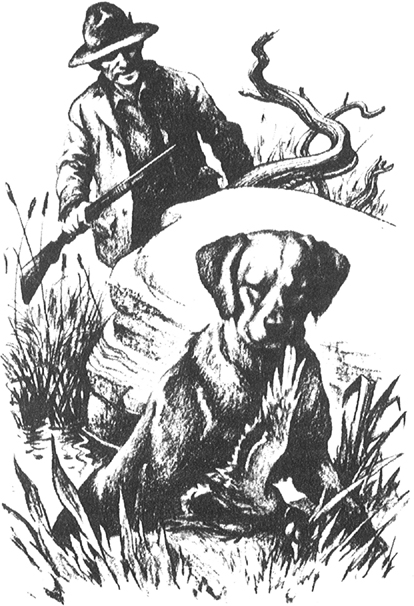
The sound of a shot and the splash of a duck had had the same effect on the Labrador as a trumpet call to an old war horse, and drew him as irresistibly. Without a second’s hesitation he had plunged in for the retrieve, only to find that he was unable to open his mouth to grasp the heavy duck properly, and was forced to tow it ashore by a wingtip. He emerged from the water twenty feet from the man, the beautiful greenhead trailing from its outstretched wing, the sun striking the iridescent plumage. The Labrador looked doubtfully at the stranger, and Mackenzie stared back in open-mouthed amazement. For a moment the two were frozen in a silent tableau, then the man recovered himself.
“Good dog!” he said quietly, holding out one hand. “Well done! Now bring it to me.” The dog advanced hesitantly, dragging the bird.
“Give!” said Mackenzie, as the dog still hesitated.
The dog walked slowly forward, releasing his hold, and now Mackenzie saw with horror that one side of his face was swollen out of all proportion, the skin stretched so tautly that the eyes were mere slits and one rigid lip pulled back over the teeth. Sticking out like evil little pins on a rounded cushion of raw skin were several quills, deeply imbedded. Every rib showed up under the wet coat, and when the dog shook himself Mackenzie saw him stagger.
Mackenzie made up his mind quickly: no matter whose, this dog was desperately in need of urgent treatment; the quills must be extracted at once before the infection spread further. He picked up the ducks, patted the dog’s head reassuringly, then “Heel!” he said firmly. To his relief the dog fell in behind unquestioningly, following him back to the farmhouse, his resistance weakened to the point where he longed only to be back in the well-ordered world of human beings, that solid world where men commanded and dogs obeyed.
Crossing the fields, the stranger padding trustingly at his heels, Mackenzie suddenly remembered the other dog, and frowned in bewilderment. How many more unlikely dogs in need of succor would he lead into the farmhouse kitchen today—a lame poodle this afternoon, a halt beagle tonight?
His long, early morning shadow fell over the woodpile, and the sleepy Siamese cat sunning himself there lay camouflaged by stillness as he passed, unobserved by the man, but acknowledged by the dog with a brief movement of his tail and head.
Mackenzie finished cleaning up the Labrador’s face nearly an hour later. He had extracted the quills with a pair of pliers; one had worked its way into the mouth and had to be removed from within, but the dog had not growled once, only whimpering when the pain was most intense, and had shown pathetic gratitude when it was over, trying to lick the man’s hands. The relief must have been wonderful, for the punctures were now draining freely, and already the swelling was subsiding.
All through the operation the door leading out of the kitchen to a back room had shaken and rattled to the accompaniment of piteous whining. The old dog had been so much in the way when Mackenzie was working, pushing against his hand and obviously worried that they were going to do his companion some harm, that Nell had finally enticed him out with a bone, then quickly shut the door on his unsuspecting face.
Now, still deeply suspicious of foul play, he was hurling himself against the door with all his weight, but they did not want to let him in yet until the other dog had finished a bowl of milk. Mackenzie went to wash his hands, and his wife listened to the anxious running feet and the thuds that followed until she could bear it no longer, certain that he would harm himself. She opened the door and the old dog shot out in a fury, prepared to do battle on behalf of his friend—but he drew up all standing, a comical, puzzled expression on his face as he saw him peacefully lapping up a bowl of milk. Presently they sat down together by the door and the young dog patiently suffered the attentions of the other.
It was evident by their recognition and devotion that they came from the same home—a home which did not deserve to have them, as Nell said angrily, still upset by the gaunt travesty of a dog that had appeared; but Mackenzie pointed out that they must have known care and appreciation, as both had such friendly, assured dispositions. This made it all the harder to understand why they should be roaming such solitary and forbidding country, he admitted. But perhaps their owner had died, and they had run away together, or perhaps they had been lost from some car traveling across country, and were trying to make their way back to familiar territory. The possibilities were endless, and only one thing was certain—that they had been on the road long enough for scars to heal and quills to work their way inside a mouth; and long enough to know starvation.
“So they could have come from a hundred miles away or more,” said Mackenzie. “From Manitoba, even. I wonder what they can have lived on, all that time—”
“Hunting? Scrounging at other farms? Stealing, perhaps?” suggested Nell, who had watched with amusement in the kitchen mirror her early morning visitor sliding a piece of bacon off a plate after breakfast when he thought her back was turned.
“Well, the pickings must have been pretty lean,” said her husband thoughtfully. “The Labrador looks like a skeleton—he wouldn’t have got much farther. I’ll shut them in the stable when I go to Deepwater; we don’t want them wandering off again. Now, Nell, are you quite sure that you want to take on two strange dogs? It may be a long time before they’re traced—they may never be.”
“I want them,” she said simply, “for as long as they will stay. And in the meantime we must find something else to call them besides ‘Hi!’ or ‘Good dog.’ I’ll think of something while you’re away,” she added, “and I’ll take some more milk out to the stable during the morning.”
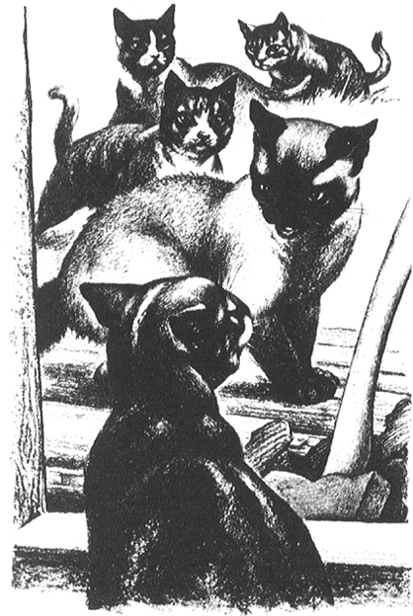
From his sunny observation post on the woodpile, the cat had watched Mackenzie cross the yard and usher the two dogs into a warm, sweet-smelling stable, shutting the door carefully behind him. Shortly afterwards the truck rattled down the farm road, then all was quiet again. A few curious farm cats were emboldened to approach the woodpile, resenting this exotic stranger who had taken possession of their favorite sunning place. The stranger was not fond of other cats at the best of times, even his own breed, and farm cats were beyond the pale altogether. He surveyed them balefully, considering his strategy. After two or three well-executed skirmishes the band dispersed, and the black-masked pirate returned to his lair to sleep.
Halfway through the morning he awoke, stretched, and jumped down, looking warily around before stalking over to the stable door. He bleated plaintively and was answered by a rustle of straw within. Leisurely, he gathered himself for a spring, then leaped effortlessly at the latch on the door. But he was not quite quick enough; the latch remained in position. Annoyed, unused to failure, he sprang again, this time making sure of success. For a split second, almost in the same impetus as the spring, one paw was Curved around the wooden block handle supporting his weight, while the other paw released the latch above and the door swung open. Purring with restrained pleasure, the cat walked in, suffering a boisterous welcome from his old friend before investigating the empty bowl. Disappointed, he left the stable, the two dogs following him into the sunlit yard, and disappeared into the henhouse. Several enraged and squawking fowls rushed out as he made his way towards the nesting-boxes. Curving his paws expertly around a warm brown egg, he held it firmly, then cracked it with a neat sideways tap from a long incisor tooth, the contents settling intact on the straw. He had brought this art to perfection after years of egg stealing. He lapped with delicate unhurried thoroughness, helping himself to two more before retiring to his woodpile again.
When Mackenzie drove into the farmyard later on in the afternoon he was surprised to see the two dogs sleeping in the sun by the shelter of the cattle trough. They stood by the truck wagging their tails in recognition as he unloaded, then followed him into the farmhouse.
“Did you let them out of the stable, Nell?” he asked, opening a parcel at the kitchen table and sheepishly dropping a meaty bone into the shark-like mouth that had opened beside him.
“Of course not,” she answered in surprise. “I took them out some milk, but I remember being particularly careful to close the door.”
“Perhaps the latch wasn’t down properly,” said Mackenzie. “Anyway, they’re still here. The Lab’s face looks better already—he’ll be able to eat a decent meal by this evening, I hope; I’d like to get some meat on those bones.”
Nothing was known of the runaways in Deepwater, he reported, but they must have come from the east, for a mink breeder at Archer Creek had spoken of chasing a white dog off his doorstep the night before, mistaking it for a local white mongrel well known for his thieving ways. Most men thought the Labrador could have been lost from a hunting trip, but nobody could account for an unlikely bull terrier as his companion. The Indian Agent had offered to take the Labrador if nobody turned up to claim him, as his own hunting dog had recently died.…
“Indeed he will not!” Nell broke in indignantly.
“All right,” said her husband, laughing. “I told him we would never separate them, and of course we’ll keep them as long as we can—I’d hate to think of one of my own dogs running loose at this time of year. But I warn you, Nell, that if they are heading somewhere with a purpose, nothing on earth will keep them here—even if they’re dropping on their feet, the instinct will pull them on. All we can do is keep them shut in for a while and feed them up. Then, if they leave, at least we’ve given them a better start.”
After supper that night the Mackenzies and their guests moved into the little back room: a cozy, pleasantly shabby place, its shelves still filled with children’s books, tarnished trophies and photographs; while snowshoes, mounted fish and grandchildren’s drawings jostled one another for space on the walls with award ribbons, pedigrees and a tomahawk. Mackenzie sat at a table, puffing peacefully on a pipe, and working at the minute, intricate rigging of a model schooner, while his wife read Three Men in a Boat aloud to him. The replete and satisfied Labrador had eaten ravenously that evening, cleaning up bowls of fresh milk and plates of food with a bottomless appetite. Now he lay stretched full length under the table in the deep sleep of exhaustion and security, and the terrier snored gently from the depths of an old leather sofa, his head pillowed on a cushion, four paws in the air.
The only disturbance during the evening was the noise of a tremendous cat battle out in the yard. Both dogs sat up immediately and, to the astonishment of the elderly couple watching, wagged their tails in unison, wearing almost identical expressions of pleased and doting interest.
Later on they followed Mackenzie out quite willingly to the stable, where he piled some hay in a corner of a loose box for them, filled the bowl with water, then shut the door firmly behind him—satisfying himself that the latch was down and firmly in place, and would remain so even when the door was rattled. Shortly afterwards the lights downstairs in the farmhouse went out, followed in a little while by the bedroom light upstairs.
The dogs lay quietly in the darkness, waiting. Soon there was a soft scrabbling of paws on wood, the latch clicked, and the door opened a fraction, just enough to admit the slight body of the cat. He trampled and kneaded the hay for a while, purring in a deep rumble, before curling up in a ball at the old dog’s chest. There were several contented sighs, then silence reigned in the stable.
When the young dog awoke in the cold hour before dawn only a few pale laggard stars were left to give the message which his heart already knew—it was time to go, time to press on westwards.
The yawning, stretching cat joined him at the stable door; then the old dog, shivering in the cold dawn wind; and for a few minutes the three sat motionless, listening, looking across the still dark farmyard, where already they could hear the slight stirrings of the animals. It was time to be gone: there were many miles to be traveled before the first halt in the warmth of the sun. Silently they crossed the yard and entered the fields leading to the dark, massed shadows of the trees in the farthermost corner, their paws making three sets of tracks in the light rime of frost that covered the field; and even as they turned onto a deer trail leading westward through the bush, a light came on upstairs in the farmhouse.…
Ahead of them lay the last fifty miles of the journey. It was as well that they had been fed and rested. Most of the way now lay through the Strellon Game Reserve, country that was more desolate and rugged than anything they had yet encountered. The nights would be frosty, the going perilous and exhausting; there could be no help expected from any human agency. Worst of all, their leader was already weak and unfit.