5
THE TRIO journeyed on, the pattern of the next few days being very much the same, free of incident or excitement. Leaving their resting place at daylight, they would jog steadily along by day, their pace determined mainly by the endurance of the old dog. Their favorite sleeping places were hollows under uprooted trees where they were sheltered from the wind, and able to burrow down among the drifted leaves for warmth. At first there were frequent halts and rests, but daily the terrier became stronger; after a week he was lean, but the scars on his shoulders were healing, and his coat was smooth and healthy; in fact, he was in better condition and looked younger and fitter than at the outset of the journey. He had always had a happy disposition, and most of the time looked perfectly content, trotting along through the vast stillness of the bush with stolid, unalterable good humor. He was almost always hungry, but that skillful hunter the cat kept him provided with food which, while scarcely ever satisfying, was adequate by his new standard of living.
It was only the famished young dog who really suffered, for he was not a natural hunter, and wasted a lot of ill-afforded energy in pursuit. He lived mainly on frogs, mice, and the occasional leavings of the other two; sometimes he was lucky enough to frighten some small animal away from its prey, but it was a very inadequate diet for such a large and heavily built dog, and his ribs were beginning to show through the shining coat. He was unable to relax, his constant hunger driving him to forage even when the other two were resting; and he never joined them in their amiable foolery, when sometimes the cat would skitter away in pretended fear from the growling, wagging white dog, often ending in being chased up a tree. Then the Labrador would sit apart, aloof and watchful, nervous and tense. It seemed as though he were never able to forget his ultimate purpose and goal—he was going home; home to his own master, home where he belonged, and nothing else mattered. This lodestone of longing, this certainty, drew him to lead his companions ever westward through wild and unknown country, as unerringly as a carrier pigeon released from an alien loft.
Nomadic life seemed to agree with the cat. He was in fine fettle, sleek and well groomed and as debonair as ever, and had adapted himself so well that at times it appeared as though he were positively enjoying the whole expedition. Sometimes he left the other two for an hour or so at a time, but they had ceased to pay any attention to his absence now, as sooner or later he always reappeared.
They traveled mostly on old abandoned trails, astonishingly plentiful in this virtually uninhabited region; occasionally, they cut straight through the bush. It was fortunate that the Indian summer weather still continued for the short thin coat of the bull terrier could not withstand low temperatures, and although a thicker undercoat was already growing in to compensate it would never be adequate. The cat’s coat, too, was thickening, making him appear heavier; the Labrador’s needed no reinforcement and was already adapted to all extremes, the flat, thick hairs so close together that they made an almost waterproof surface. The short days were warm and pleasant when the sun was high, but the nights were cold: one night, when there was a sudden sharp frost, the old dog shivered so much that they left the shallow cave of their resting place soon after a bright-ringed moon rose and traveled through the remainder of the night, resting most of the following morning in the warmth of the sun.
The leaves were losing their color rapidly, and many of the trees were nearly bare, but the dogwood and pigeonberry by the sides of the trail still blazed with color, and the Michaelmas daisies and fireweed flourished. Many of the birds of the forest had already migrated; those that were left gathered into great flocks, filling the air with their restless chatter as they milled around, the long drawn-out streamers suddenly wheeling to form a clamorous cloud, lifting and falling in indecision. They saw few other animals: the noisy progress of the dogs warned the shy natural inhabitants long before their approach; and those that they did meet were too busy and concerned with their winter preparations to show much curiosity. The only other bear that they had encountered was sleek and fat as butter, complacent and sleepy, his thoughts obviously already running on hibernation, and quite uninterested in strange animals. He was, in fact, sitting on a log in the sun when the animals saw him; after giving them a sleepy inspection from his little, deep-set eyes he yawned and continued the lazy scratching of his ear. The cat, however, growled angrily to himself for nearly an hour after this encounter.
The rabbits and weasels had changed to their white winter coats; a few snow buntings had appeared, and several times they had heard the wild, free, exultant calling of the wild geese, and had looked up to see the long black V-shaped skeins passing overhead on the long journey southwards. The visitors to the northlands were leaving, and those who remained were preparing themselves for the long winter that lay ahead. Soon the whole tempo, the very pulse of the North, would beat slower and slower until the snow fell like a soft coverlet; then, snug and warm beneath in dens and burrows and hollows, the hibernating animals would sleep, scarcely breathing in their deep unconsciousness, until the spring.
As though aware of these preparations and their meaning, the three adventurers increased their pace as much as was possible within the limits determined by the old dog’s strength. On good days they covered as much as fifteen miles.
Since they had left the Indian encampment on the shores of the rice lake they had not seen any human beings, or any sign of human habitation, save once at nightfall when they were nosing around a garbage can outside the darkened cookhouse of a lumber camp deep in the very heart of the bush. Marauding bears had been there recently—their rank, heavy smell still hung on the air, and the cat refused to come nearer, but the old dog, watched by the other, tipped over the heavy can, then tried to pry off the lid with a practiced nose. The can rattled and banged loudly on some rocks and neither dog heard the door opening in the dark building behind. Suddenly a blast of shot ripped through the bottom of the can, blowing the lid off and strewing the contents all over the old dog. Deafened and stunned, he stood for a moment, shaking his head; a second shot clanged against metal and brought him to his senses—he grabbed a bone in passing from the plenty strewn all around, and dashed after the Labrador, running so fast that he outdistanced him. A spray of pellets followed, stinging into their hindquarters so that they leaped simultaneously and redoubled their speed. Soon they were in the shelter of the bush, but it was a long time before they halted for the night. The old dog was so exhausted that he slept until dawn. The pellets had been only momentarily painful, but the incident increased the young dog’s wary nervousness.
However, a few days later, despite his care, they had another unexpected encounter. They were drinking at midday from a shallow ford crossing an overgrown track to a worked-out silver mine when a cottontail started up in the bracken across the water. The young dog sprang after, drenching the other two, and they watched the chase—the rabbit’s head up, the dog’s down, linked in a swerving, leaping rhythm of almost balletlike precision—until it disappeared among the trees.
The terrier shook his coat, spraying the cat again; furious, the cat stalked off.
Alone now, with a brief moment of freedom from the constant daytime urging, the old dog made the most of it. He pottered happily around the lichened rocks and mossy banks, savoring everything with his delicate connoisseur’s nose; he flicked the caps of several large fawn mushrooms in some displeasure; a shiny black beetle received his keen attention for a while and he followed it like a bloodhound. Presently he lost interest and sat on it. He yawned, scratched his ear, then rolled lazily on a patch of dried mud. Suddenly he lay quite still, his paws dangling limply, his head turned back on the ground towards the trail: he freed a crumpled ear to listen more intently, then his tail registered his pleased anticipation—someone was walking through the bush towards him. He scrambled to his feet and peered shortsightedly down the trail, his tail curving his hindquarters from side to side in welcome. When an old man carrying a canvas bag appeared, talking quietly to himself, the bull terrier stepped out and awaited him. The old man did not pause: small and bent, he hobbled quickly past, lifting an ancient green felt hat from a crown of white hair as he went, and nodding to the dog with a brief smile of great sweetness. Two little gray-and-white chickadees preceded him, flitting from branch to branch over his head. The old dog fell in contentedly behind. Soon the cat appeared in the distance, running to catch up, his eyes on the chickadees; and far behind the cat again, his mouth framed around the dangling carcass of a rabbit, came the triumphant but deeply suspicious Labrador.
The straggling procession continued along the cool, green tunnel of the trail for half a mile, until the trees thinned out and they came upon a small cabin set back in a clearing within sight of the derelict mine workings. They passed, one after the other, through a small, neatly raked garden, between brown raspberry canes and leafless apple trees, and walked slowly up the few steps to the porch. Here the old man set his bag down, knocked on the green door, paused, then opened it, standing courteously aside to motion his following in before him. The old dog walked in, the cat closely by his shoulder, then the man. The young dog hesitated by the trail’s side, his eyes round and distrustful above his burden, then, apparently reassured by the open door, he carefully laid the rabbit down behind a bush, scratching a layer of leaves over it, and, this done, followed the others. They stood in an expectant ring in the middle of the cabin, savoring a delicious, meaty smell.
They watched the old man brush the brim of his hat, hang it on a peg, then hobble over to a small, gleaming wood stove and thrust in another log, washing his hands afterwards in a basin filled from a dipper of water. He lifted the lid off a pot simmering on the stove, and the three watchers licked their lips in anticipation. As he took down four gold-rimmed plates from a dresser, a chipmunk appeared from behind a blue jug on the top shelf. Chattering excitedly he ran up the man’s arm to his shoulder, where he sat and scolded the strangers with bright jealous eyes, his little striped body twitching with fury. Two gleaming lamps appeared in the darkness of the cat’s face and his tail swished in response, but he restrained himself in deference to his surroundings.
The old man chided the chipmunk lovingly as he set four places at the table, handing it a crust which bulged its cheeks, then ladling four very small portions of stew onto the plates. The little animal’s noise fell away to an occasional disgruntled squeak, but he ran from shoulder to shoulder to keep watch on the cat. The old dog edged nearer. Looking very small behind a high-backed chair, the old man stood for a moment with his clear, childlike blue eyes closed and his lips moving, then drew out his chair and sat down. He looked around the table, suddenly irresolute; then his brow cleared, and he rose to draw up the two remaining chairs and a bench. “Do sit down,” he said, and at the familiar command the three animals behind him sat obediently.
He ate slowly and fastidiously. Two pairs of hypnotized eyes followed every movement of the fork to his mouth; the third pair remained fixed on the chipmunk. Presently the plate was empty, and the old man smiled around the table; but his smile turned again to bewilderment as he saw the three untouched plates. He considered them long and thoughtfully, then shrugged his shoulders and moved on to the next place. Soon that too came to its confusing end, and, sighing, he moved again. Spellbound, his visitors remained rooted to the floor. Even the old dog, for once, was nonplussed: although he shivered in anticipation and saliva ran from his mouth at the enticing smell, he remained sitting as custom and training decreed.
The old man sat on when the last plate was emptied, lost in his own world, his peaceful stillness diffusing through the little cabin so that the watchers sat graven in their places. A little wind stirred outside, swinging the door wide open on creaking hinges. A grosbeak flew in, to perch on the top, the mellow fall sunshine slanting on his brilliant plumage, and it seemed as though the living silence of the great forest around surged up and in through the open door with the bird’s coming, so that the animals stirred uneasily, glancing behind them.
The chipmunk’s shrill voice cut through the silence, and its claws scrabbled up the dresser as the cat half sprang—but recollected himself in time and slipped out of the door after the grosbeak instead. In a sudden awakening the old man had started to his feet; he looked around as though wondering where he was, his eyes lighting in surprise on the two dogs by the door. Slow recognition dawned on his face and he smiled down affectionately though his gaze looked through and beyond them. “You must come more often,” he said; and to the old dog, who stood wagging his tail at the gentle warmth in the voice, “Remember me most kindly to your dear mother!”
He escorted the dogs to the door; they filed past him, their tails low and still, then walked slowly and with great dignity down the little winding path between the raspberry canes and the apple trees to the overgrown track. Here they waited for a moment while the young dog furtively uncovered his prize, and the cat joined them; then, without looking back, they trotted in close formation out of sight between the trees.
A quarter of a mile farther on the young dog looked carefully around before dropping his rabbit. He nudged it with his nose several times, then turned it over. A moment later its red-stained fur lay scattered and both dogs were eating ravenously, growling amicably as they crunched. The cat sat, flexing his claws as he watched. After a while he rose on his hind legs and stretched his forepaws to their full extent against a tree, then methodically sharpened their claws on the bark. His head turned sharply and he paused, still standing, at a rustle in the long dead grass: a split second later he pounced in a bounding arc; a paw flashed out, pinned down and held, his head bent down; and a small squeaking broke off abruptly. Before the dogs were even aware that he had gone he was back again by his tree, cleaning his whiskers with soft rounded paws.
The following day the travelers came down from the hills to find themselves on the banks of a river running north and south. It was about a hundred feet across to the far bank, and although shallow enough in the ordinary way, was far too deep for the animals to cross without swimming. The young dog led the way downstream for some distance looking for a means of crossing, as it was obvious that his companions would not even wet their feet if they could possibly help it, both sharing a great dislike of water. Once or twice he plunged in and swam around, looking back at the other two, obviously trying to entice them by showing them how easy it was, but they remained sitting close together on the bank, united in misery, and he was forced to continue trotting downstream, becoming increasingly worried as he went, aware that it was the wrong direction.
It was lonely, uninhabited country, so that there were no bridges, and the river if anything became wider as they trotted along the banks. After three or four miles the young dog could endure the frustration no longer; he plunged into the water and swam rapidly and strongly across to the far side, his tail streaming out behind like an otter’s. He loved the water, and was as much at home in it as the other two hated and feared it. He stood on the far bank, barking encouragingly, but the old dog whined in such distress, the cat yowling in chorus, that he swam across again, paddling around in the shallows near the bank. The old dog walked gingerly into the shallow water, shivering and miserable, turning his head away. Once more the Labrador swam the river, climbed out on the far side, shook himself, and barked. There was no mistaking the command. The old dog took another reluctant step forward, whining piteously, his expressive tail tucked under. The barking continued; again the terrier advanced; again the Labrador swam across to encourage him. Three times he swam across, and the third time the old dog waded in up to his chest and started swimming. He was not a very good swimmer; he swam in jerky rapid movements, his head held high out of the water, his little black eyes rolling fearfully; but he was a bull terrier, a “white cavalier,” and he kept on, following the wake of the other, until at last he climbed out on the far side. His transports of joy on reaching dry land were like those of a shipwrecked mariner after six weeks at sea on a raft: he rushed in circles, he rolled on his back, he ran along with alternate shoulders low in the long grass to dry himself, until finally he joined the Labrador on the bank to bark encouragingly at the cat.
The poor cat now showed the first signs of fear since leaving on his journey; he was alone, and the only way to rejoin his friends lay in swimming across the terrible stretch of water. He ran up and down the bank, all the time keeping up his unearthly Siamese wailing. The young dog went through the same tiring performance that he had used before, swimming to and fro, trying to entice him into the water; but the cat was beside himself with terror and it was a long long time before he finally made up his mind. When he did it was with a sudden blind desperate rush at the water, completely un-catlike. His expression of horror and distaste was almost comical as he started swimming towards the young dog who waited for him a few yards out. He proved to be a surprisingly good swimmer, and was making steady progress across, the dog swimming alongside, when tragedy struck.
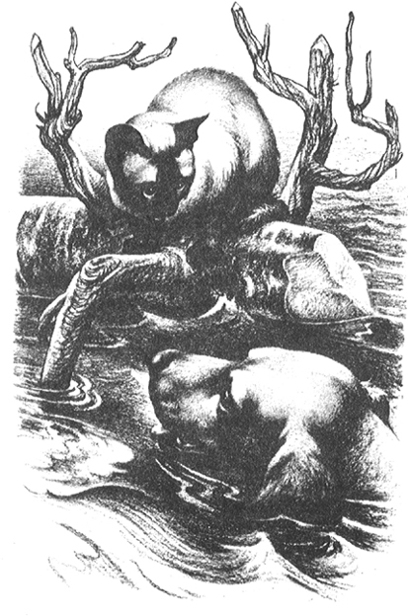
Many years before a colony of beavers had dammed a small creek which had tumbled into the river about two miles upstream. Since the beavers had left, the dam had been crumbling and loosening gradually, until it had become just a question of time before it would give way altogether, and drain the flooded land behind. Now, by a twist of fate, a rotting log gave way and a large section bulged forward under the added strain. Almost as the two animals reached midstream the dam broke altogether. The pent-up force of the unleashed creek leaped through the gap in an ever-widening torrent, carrying everything before it and surging into the river, where it became a swift mountainous wave—carrying small trees, torn-away branches, pieces of riverbank and beaver dam before it on the crest. The young dog saw the onrushing wave several moments before it reached them, and frantically tried to swim into a position upstream of the cat, instinctively trying to protect him; but he was too late, and the great curling, crested wave surged over, submerging them in a whirling chaos of debris. The end of a log struck the cat full on the head; he was swept under and over and over until his body was finally caught on a half-submerged piece of the old dam, and was carried along on the impetus of the wave as it tore down the river bed.
The old dog, barking wildly in anxiety—for he had sensed the disaster although he could not see it—waded chest-deep into the churning water, but its force knocked him back again, breathless and choking; he was forced to retreat.
The other dog, strong swimmer though he was, made his way to the bank only with the greatest difficulty. Even then he was carried almost half a mile downstream before his feet were on firm ground. Immediately he set off, down the riverside, in pursuit.
Several times he saw the little figure of the cat, half under water, surging ahead on the swift white crest; but he was never near enough, except at one point where the partially submerged piece of beaver dam caught on an overhanging branch. He plunged in immediately; but just as he was nearly within reach it tore free and once more went whirling down the river until it was lost to sight.
Gradually the dog fell farther and farther behind. At last he was brought to a complete halt when the river entered a rocky gorge with no foothold on either side. He was forced to climb inland, and by the time he rejoined the river bank on the far side of the gorge there was no sign of the cat.
It was nearly dark when he returned to find the terrier, who was walking wearily towards him along the riverbank; the Labrador was exhausted, limping, and utterly spent and miserable—so much so that he barely returned the greeting of the bewildered and lonely old dog but dropped to the ground, his flanks heaving, and lay there until thirst drove him to the water’s edge.
They spent that night where they were, by the bank of the river, peaceful at last after the violence of the afternoon. They lay curled closely together for comfort and warmth, and when a thin, cold rain fell as the wind rose they moved under the spreading branches of an old spruce for shelter.
In the middle of the night the old dog sat up, trembling all over with cold. He threw his head back and howled his requiem of grief and loneliness to the heavy, weeping sky; until at last the young dog rose wearily and led him away from the river, long before dawn broke, and over the hills to the west.