
It was an emergency, the text said. An SOS emergency. Pip knew immediately that that could only mean one thing.
She grabbed her car keys, yelled goodbye to her mom and Josh, and rushed out the front door.
She stopped by the store on her way to buy a king-size chocolate bar to help mend Lauren’s king-size broken heart.
When she pulled up outside the Gibsons’ house, she saw that Cara had had the exact same idea. Except Cara’s post-breakup first-aid kit was more extensive than Pip’s; she had also brought a box of tissues, chips and dip, and a rainbow array of face mask packets.
“Ready for this?” Pip asked Cara, hip-bumping her in greeting.
“Yep, well prepared for the tears.” She held up the tissues, the corner of the box catching the ends of her curly ash-brown hair.
Pip pressed the doorbell, and both of them winced at the mechanical song.
Lauren’s mom answered the door.
“Oh, the cavalry is here.” She smiled. “She’s upstairs in her room.”
They found Lauren fully submerged in a duvet fort on the bed, the only sign of her existence a splay of ginger hair poking out from the bottom. It took a full minute of coaxing and chocolate bait to get her to surface.
“First,” Cara said, prying Lauren’s phone from her fingers, nails bitten to the quick, “you’re banned from looking at this for the next twenty-four hours.”
“He did it by text!” Lauren wailed, blowing her nose and shooting an entire swamp into the tissue.
“Boys are dicks,” Cara said, putting her arm around Lauren and resting her sharp chin on her shoulder. “You could do so much better than him.”
“Yeah.” Pip broke Lauren off another line of chocolate. “Besides, Tom always said ‘pacifically’ when he meant ‘specifically.’ ”
Cara pointed eagerly at Pip in agreement. “Massive red flag.”
“I pacifically think you’re better off without him,” said Pip.
“I atlantically think so too,” added Cara.
Lauren gave a wet snort of laughter, and Cara winked at Pip; an unspoken victory.
“Thanks for coming, guys,” Lauren said tearfully, her pale eyes swollen and puffy. “I didn’t know if you would. I’ve probably neglected you for half a year to hang out with Tom. And now I’ll be third-wheeling two best friends.”
“That’s crap,” Cara said. “We’re all best friends.”
“Yeah.” Pip nodded. “Us, and those three mediocre boys we allow to bask in our delightful company.”
Cara and Lauren laughed. The boys—Ant, Zach, and Connor—were all currently away during the summer break.
But of her friends, Pip had known Cara the longest, and yes, they were closest. An unsaid thing. They’d been inseparable ever since six-year-old Cara had hugged a tiny, friendless Pip and asked, “Do you like bunnies too?”
They were each other’s crutch to lean on when life got too much to carry alone. Pip, though only ten at the time, had helped Cara through her mom’s diagnosis and death. And Pip had been her constant two years ago when Cara came out, ready with a steady smile and phone calls into the early hours. Cara’s wasn’t the face of a best friend; it was the face of a sister.
By extension, Cara’s family was Pip’s second. Mr. Ward, in addition to being her history teacher, was her tertiary father figure, behind her stepdad and the ghost of her first father. Pip was at the Ward house so often she had her own mug with her name on it and pair of slippers to match Cara’s and her older sister, Naomi’s.
“OK.” Cara lunged for the TV remote. “Rom-coms or films where boys get violently murdered?”
It took roughly one and a half terrible films from the Netflix backlog for Lauren to wade through denial and extend a cautionary toe toward acceptance.
“I should get a haircut,” she said. “That’s what you’re supposed to do.”
“I’ve always said you’d look good with short hair,” said Cara.
“And do you think I should get my nose pierced?”
“Ooh, yeah.” Cara nodded.
“I don’t see the logic in putting a nose hole in your nose hole,” said Pip.
“Another Pip quote for the books.” Cara feigned writing it down in midair. “What was the one that got me the other day?”
“The sausage one.” Pip sighed.
“Oh yeah,” Cara snorted. “So, Laur, I was asking Pip which pajamas she wanted to wear, and she just casually says, ‘It’s sausage to me.’ And didn’t realize why that was a weird response.”
“It’s not that weird,” said Pip. “My grandparents from my first dad are German. ‘It’s sausage to me’ is a German saying; just means ‘I don’t care.’ ”
“Or you’ve got a sausage fixation.” Lauren laughed.
“Says the daughter of a porn star,” Pip quipped.
“Oh my god, how many times? He only did one nude photoshoot in the eighties, that’s it.”
“So, on to boys from this decade,” Cara said, prodding Pip on the shoulder. “Did you go see Ravi Singh yet?”
“Questionable segue. But yes, and I’m going back to interview him tomorrow.”
“I can’t believe you’ve already started your capstone project,” Lauren said with a dying-swan dive back onto the bed. “I want to change mine already; famines are depressing.”
“I imagine you want to interview Naomi sometime soon.” Cara looked pointedly at Pip.
“Yeah….Can you warn her I might be stopping by next week?”
“Sure,” Cara said, then hesitated. “She’ll agree to it and everything, but can you go easy on her? She still gets really upset about it sometimes. I mean, he was one of her best friends. Actually, probably her best friend.”
“Yeah, of course,” Pip said. “What do you think I’m going to do? Pin her down and beat responses out of her?”
“Is that your tactic for Ravi tomorrow?”
“Ha.”
Lauren sat up then, with a snot-sucking sniff so loud it made Cara visibly flinch.
“Are you going to his house, then?” she asked.
“Yeah.”
“But…what are people going to think if they see you going into Ravi Singh’s house?”
“It’s sausage to me.”
PIPPA FITZ-AMOBI
8/1/19
I’m biased; I know I am. For reasons I don’t even know how to explain to myself, I want Sal Singh to be innocent. Reasons carried with me since I was twelve years old, inconsistencies that have nagged at me these past five years.
But if I’m actually going to solve anything, I have to be aware of confirmation bias. So I thought it would be a good idea to interview someone who is utterly convinced of Sal’s guilt.
Stanley Forbes, a journalist at the Fairview Mail, just responded to my email, saying I could call any time today. He covered a lot of the Andie Bell case in the local press and was even present at the court hearing when she was declared dead a year and a half later. To be honest I think he’s a poor journalist, and I’m pretty sure the Singhs could sue him for defamation and libel about a dozen times over. I’ll type up the transcript here right after.
PIP: Hi, Stanley. This is Pippa; we were emailing earlier.
STANLEY: Yep, yeah, I know. You wanted to pick my brain about the Andie Bell/Salil Singh case, right?
PIP: Yes, that’s right. Do you mind if I record our conversation?
STANLEY: Sure, shoot.
PIP: OK, thanks. Um, so first, you attended the court hearing that established Andie as legally dead, correct?
STANLEY: Sure did.
PIP: Since the national press didn’t elaborate much further than reporting the verdict, I was wondering if you could tell me what kind of evidence was presented?
STANLEY: Uh, so the main investigator on Andie’s case outlined the details of her disappearance—the times and so on. And then he moved on to the evidence that linked Salil to her murder. They made a big deal about the blood in the trunk of her car; they said this suggested that she was murdered and her body was put in the trunk to be transported somewhere else. They said something like “It seems clear that Andie was the victim of a sexually motivated murder, and considerable efforts were made to dispose of her body.”
PIP: And did Detective Richard Hawkins or any other officer provide a timeline of what they believed were the events of that night and how Sal allegedly killed her?
STANLEY: Yeah, I kinda remember that. Andie left home in her car, and at some point on Salil’s walk home, he intercepted her. With either him or her driving, he took her to a secluded place and murdered her. He put her in the trunk and then drove somewhere to hide or dispose of her body. Mind you, well enough that it hasn’t been found in five years; must have been a pretty big hole. And then he ditched the car on that road where it was found—Monroe, I think—and he walked home.
PIP: So because of the blood in the trunk, the police believed that Andie was killed somewhere and then hidden in a different location?
STANLEY: Yep.
PIP: OK. In a lot of your articles about the case, you refer to Sal as a “killer,” a “murderer,” and even a “monster.” You are aware that without a conviction, you are supposed to use the word “allegedly” when reporting crime stories.
STANLEY: Not sure I need a child to tell me how to do my job. Anyway, it’s obvious that he did it, and everyone knows it. He killed her, and the guilt drove him to suicide.
PIP: And why are you so convinced Sal’s guilty?
STANLEY: Almost too many things to list. Evidence aside, he was the boyfriend, right? And it’s always the boyfriend or the ex-boyfriend. Not only that, Salil was Indian.
PIP: Well…he was actually born and raised in the United States, though it is notable you refer to him as Indian in all of your articles.
STANLEY: Well, same thing. He was of Indian heritage.
PIP: And why is that relevant?
STANLEY: I’m not like an expert or anything, but they have different ways of life from us, don’t they? They don’t treat women quite like we do. So I’m guessing maybe Andie decided she didn’t want to be with him or something, and he killed her in a rage because, in his eyes, she belonged to him.
PIP: Wow…I…Honestly, Stanley, I’m pretty surprised you still have a job.
STANLEY: That’s ’cause everyone knows what I’m saying is true.
PIP: I don’t agree. And I think it’s irresponsible to publicly call someone a murderer without using “allegedly” when there’s been no conviction. Or, even worse, calling Sal a monster. It’s interesting to compare your reporting about Sal to your recent articles on the Stratford Strangler. He murdered five people and pleaded guilty, yet in your headline you referred to him as a “lovesick young man.” Is that because he’s white?
STANLEY: That’s got nothing to do with Salil’s case; I just call it how it is. You need to relax. He’s dead. Why does it matter if people call him a murderer? It can’t hurt him.
PIP: Because his family isn’t dead.
STANLEY: Look, this is a waste of my time. You really think he’s innocent? Against the expertise of senior officers?
PIP: I just think there are certain gaps in the case against Sal, that’s all.
STANLEY: Yeah, maybe if the kid hadn’t offed himself before getting arrested, we would have been able to fill the gaps.
PIP: That was insensitive.
STANLEY: Well, it was insensitive of him to kill his girlfriend.
PIP: Allegedly!
STANLEY: You want more proof that that kid was a killer, fangirl? We weren’t allowed to print it, but my source in the police said they found a death-threat note in Andie’s school locker. He threatened her, and then he did it. Do you really still think he’s innocent?
PIP: Maybe he is. And you’re a racist, intolerant hack who—(Stanley hangs up the phone.)
Yeah, so I don’t think Stanley and I are going to be best friends. But he’s provided two pieces of information I didn’t have before. First: police believe Andie was killed somewhere before being put in the trunk of her car and driven to a second location to be disposed of. Second: this “death threat.” I haven’t seen a death threat mentioned in any articles or police statements. Maybe the police didn’t think it was relevant. Or maybe they couldn’t prove it was linked to Sal. Or maybe Stanley made it up. In any case, it’s worth remembering when I interview Andie’s friends later on.
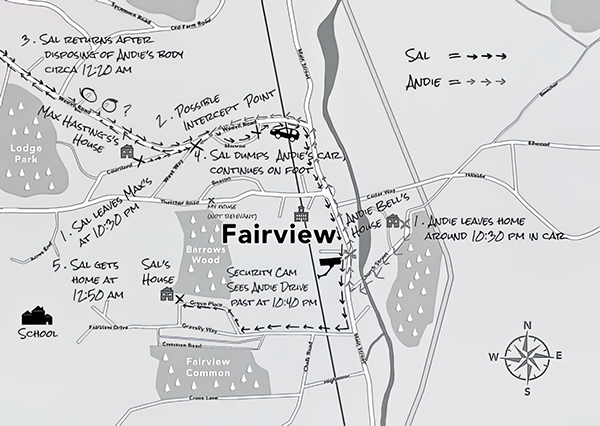
So now that I (sort of) know what the police’s version of events are for that night, and what the prosecution’s case might have looked like, it’s time for a murder map.
I had to make a couple of assumptions when creating it. The first is that there are several ways to walk from Max’s to Sal’s; I picked the one that heads back through Main Street, because Google said it was the quickest and I’m presuming most people prefer to walk on well-lit streets at night.
It also provides a good intercept point somewhere along Weevil Road, where Andie possibly pulled over and Sal got in the car. There are some quiet residential roads and a farm on Weevil Road. These secluded places—circled—could potentially be the site of the murder (according to the police’s version of events).
I didn’t bother guessing where Andie’s body was disposed because, like the rest of the world, I have no clue where that is. But given that it takes about eighteen minutes to walk from where the car was dumped on Monroe back to Sal’s house on Grove Place, I have to presume he’d have been back in the vicinity of Weevil Road around 12:20 a.m. If the Andie-and-Sal intercept happened around 10:45 p.m., this would have given Sal one hour and thirty-five minutes to murder her and hide her body. I mean, timewise, that seems perfectly reasonable to me. It’s possible.
But here I’ve spotted one of those inconsistencies. Andie and Sal both leave where they are around 10:30 p.m., so they must have planned to meet up, right? It seems too coincidental for them not to have communicated about meeting. The thing is, the police have never once mentioned a phone call or any texts between Andie and Sal that would equate to a meet-up arrangement. And if they planned this together—at school, for example, where there would be no record of the conversation—why didn’t they just agree that Andie would pick Sal up from Max’s house? It seems weird to me.